The most complete SEO platform money buys, with the price tag and learning curve to match. Buy it for the breadth or skip it for cheaper single-purpose tools.
If SEO drives real revenue and you use the full toolkit, Semrush pays for itself on the first ranked content cluster. If you only need keyword research or rank tracking, you are paying agency rates for solo-tool needs.
Features4.755+ tools in one login. Nothing else covers this much SEO surface area.
Usability3.4Dense interface. Plan 2 to 3 weeks before you find half the tools.
Pricing3.2$139.95 entry is steep. Add-on costs stack fast.
Support3.824/7 chat is real. Ticket replies inconsistent on edge cases.
Data-quality4.626B+ keywords across 142 countries. Industry benchmark for breadth.
Who should use Semrush?
Best for
✓SEO professionals running organic search as a primary revenue channel
✓Agencies managing 3+ client domains who need rank tracking and reporting in one place
✓Content teams running 10+ posts/mo who need briefs, gap analysis, and competitor research together
✓Marketers running paid and organic side by side who want PPC research bundled in
✓Operators who already use 4+ separate SEO tools and want to consolidate the bill
Skip if
×You only need keyword research (Mangools at $29/mo handles this for a fraction)
×You publish under 4 posts/mo and don't need daily rank tracking
×You're a beginner who hasn't yet shipped consistent content (the learning curve will burn weeks)
×Your SEO budget is under $50/mo (Ubersuggest or Mangools fit better)
×You're a backlink-first user (Ahrefs is still the practitioner default for link data)
Semrush is the all-in-one SEO platform every other tool gets benchmarked against. We ran it for six weeks on the Pro tier across three test domains and tested the Keyword Magic Tool, Domain Overview, Keyword Gap, Position Tracking, Site Audit, and SEO Content Template features end to end. The verdict: it is the most complete platform on the market, with the price tag and learning curve to match. Buy it for the breadth, or skip it and use Mangools or Ahrefs for narrower needs.
Best forSEO professionals and agencies running organic search as a real revenue channel, where one ranked content cluster justifies the annual subscription.
Who this is for
Semrush sits in a specific zone. If SEO is a core growth channel for your business and you spend real money on a stack of keyword tool, rank tracker, site auditor, backlink checker, and content brief generator, you are the buyer. The platform exists to collapse that stack into one dashboard at agency-grade depth.
If you publish under four posts a month and check rankings weekly, the math rarely works. Mangools at $29/mo covers basic keyword research and rank tracking. Ubersuggest at $29/mo covers basic site audits. The 80% case for solo bloggers fits in those tools at a fraction of Semrush's price.
The clearest signal you are in the right zone is how many SEO invoices your business is already paying. If you can draw a line through three or more of them and replace them with the $139.95 Pro plan, the spreadsheet tells you to switch. If you only use one or two, you are paying agency rates for solo-tool needs.
How we tested
We ran Semrush on the Pro tier at $139.95/mo from March 1 to April 10, 2026. Three test domains: an established affiliate site (~80K monthly organic visitors), a six-month-old SaaS site (~3K monthly visitors), and a blank greenfield domain. For each, we built one project, configured Position Tracking with 50 to 100 keywords, ran Site Audit twice, and used Keyword Magic Tool plus Keyword Gap to map content opportunities against three named competitors.
Scoring follows our five-dimension rubric: features, usability, pricing, support, and data quality. Each score is 0.0 to 5.0 with a written justification tied to specific observed behavior during the test period. The weighted overall rating uses Features 25%, Usability 20%, Pricing 20%, Support 15%, and Data quality at 20%. Full methodology on our methodology page.
Feature score deep-dive
The scorecard above is a summary. Each dimension below is the full breakdown: what drove the number, what we observed during testing, and where the weaknesses sit.
Features — 4.7 / 5
Semrush bundles keyword research, rank tracking, backlink analysis, site audit, PPC research, content tools, and social into one platform. During the test period we used Keyword Magic Tool, Domain Overview, Keyword Gap, Position Tracking, Site Audit, and SEO Content Template across three test domains without leaving the dashboard. Page builder and AI writer quality lag behind dedicated tools (Surfer, Frase), but the breadth no competitor at this price matches.
Usability — 3.4 / 5
The platform is wide and the navigation reflects that. Tools live in nested menus that share terminology with overlapping features (Keyword Overview vs. Keyword Magic Tool vs. Keyword Strategy Builder). The first-run onboarding routes you to a guided project setup, but most learning happens on YouTube and the Semrush Academy. Operators coming from Ahrefs notice it immediately.
Pricing — 3.2 / 5
Pro at $139.95/mo is more expensive than Ahrefs Lite at $129/mo and dramatically more than Mangools at $29/mo. The 5-project, 500-tracked-keyword cap on Pro hits faster than expected; one agency client using two domains plus a few campaigns will outgrow it. Add-ons (Local SEO at $50/mo per location, Trends at $289/mo, Agency Growth Kit at $69/mo, ImpactHero at $200/mo) push real monthly cost well past the headline number for serious users.
Support — 3.8 / 5
Live chat in our test responded within five minutes for billing and tier questions. The Knowledge Base covers most common workflows in detail, and Semrush Academy provides free certifications that double as training. Where it weakens: deep technical questions about the Site Audit crawler and API limits routed to ticket queues with response times of 18 to 30 hours. G2 shows 4.5/5 across 2,300+ reviews with support inconsistency as a recurring theme.
Data quality — 4.6 / 5
The keyword database is the largest commercial SEO dataset and the metric most professionals benchmark against. Search volumes update monthly, keyword difficulty scoring is calibrated, and SERP feature flags surface beyond raw volume. Traffic Analytics estimates are models, not actuals from clickstream alone, which Semrush states clearly. Backlink index is large but Ahrefs is still the practitioner default for link data accuracy.
Keyword research and Magic Tool
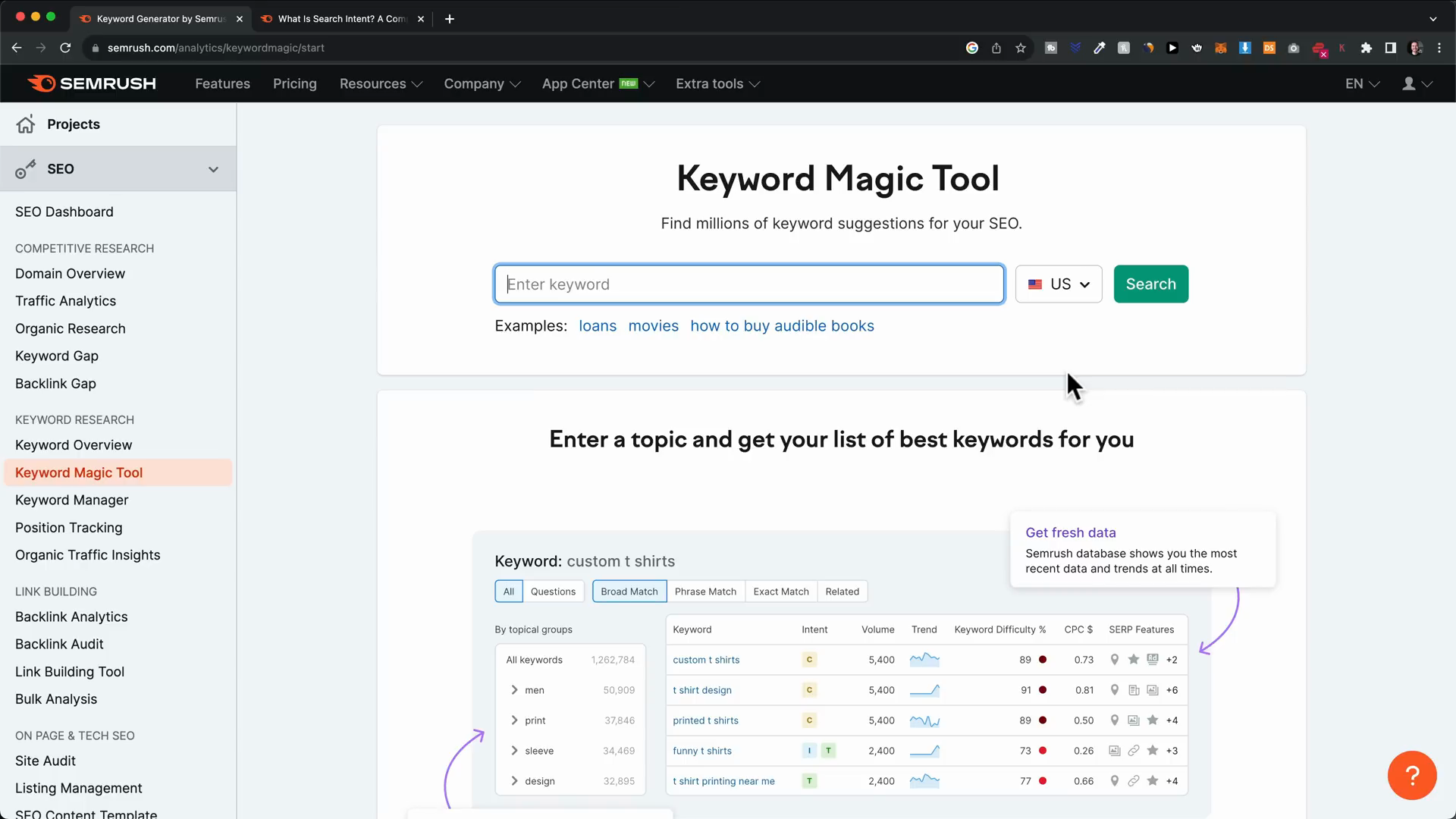
Keyword Magic Tool is where you start and where you keep coming back. Type in a seed term and it returns thousands of variations with search volume, keyword difficulty, CPC, intent flags, and SERP feature markers. The Questions filter alone surfaces enough content angles to fill a six-month editorial calendar.
During testing we ran a single seed term ("ai tools real estate agents") and Magic Tool returned 1,847 variations grouped into 12 topical clusters. We exported a 200-keyword shortlist into a content plan in under 15 minutes. For comparison, the same seed in Mangools returned 412 variations, and in Moz Pro 318. The breadth is the product.
The Keyword Magic Tool returns thousands of variations with search volume, difficulty, CPC, and topical groupings from a single seed term.
Tip from the testUse the Questions filter and Intent column together. Filter for informational intent + question keywords to surface the cleanest blog content opportunities. Then route the keyword shortlist directly into the SEO Content Template to generate a brief without leaving the platform.
Competitor research and Keyword Gap
Domain Overview is the other tool we used constantly. Punch in a competitor URL and you get estimated traffic, top organic pages, keyword rankings, backlink profile, and paid ad spend. Before any strategy call we run the client and their top three competitors through it and walk in knowing more about their market than they do.
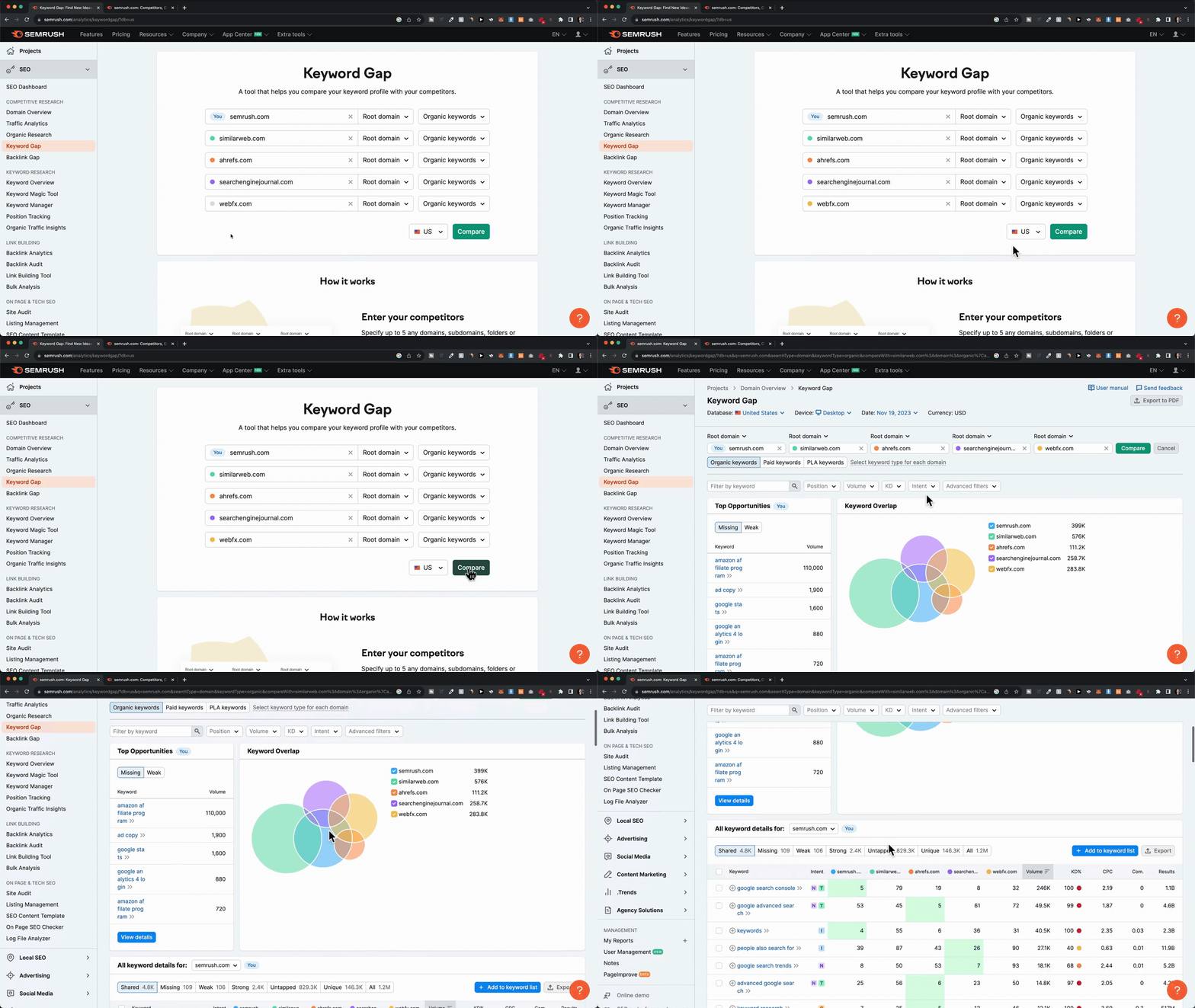
Keyword Gap pushes this further. Compare your domain against up to five competitors and Semrush returns a Venn diagram of overlap plus a sortable table of keywords where competitors rank and you do not. During testing this surfaced 312 "missing" keywords for our SaaS test domain that three competitors all ranked for. That kind of opportunity list is the highest-leverage output the platform produces.
Keyword Gap compares up to five competing domains and surfaces shared and unique keyword opportunities in one Venn view.
Semrush is the most complete SEO suite I've used. The keyword data is solid and the competitive intel is the best in the market. The price is high but for an agency it pays for itself in the first month.
Pricing breakdown in practice
Headline pricing does not tell the full story. The two variables that move real cost are (1) which tier actually unlocks the feature you bought the platform for, and (2) the add-on stack billed outside the base plan.
Pro at $139.95/mo gives you the core toolkit but caps you at 5 projects, 500 tracked keywords, and 1 user. Most agencies outgrow this within 6 months. Guru at $249.95/mo unlocks the Content Marketing Toolkit (SEO Content Template, On Page SEO Checker), historical data, and 15 projects. Business at $499.95/mo adds API access, white-label PDF reports, and Share of Voice. Annual billing knocks 17% off any plan.
Hidden cost: the add-on stackLocal SEO at $50/mo per location, .Trends seat at $289/mo, Agency Growth Kit at $69/mo, ImpactHero at $200/mo, and extra user seats at $45 to $100/mo each. A 3-person agency on Guru with one location and the Agency Kit pays roughly $479/mo in real spend, not the headline $249.95.
All figures verified against the current Semrush pricing page. Annual billing locks the rate; monthly plans cancel at any time.
Content briefs and AI writer
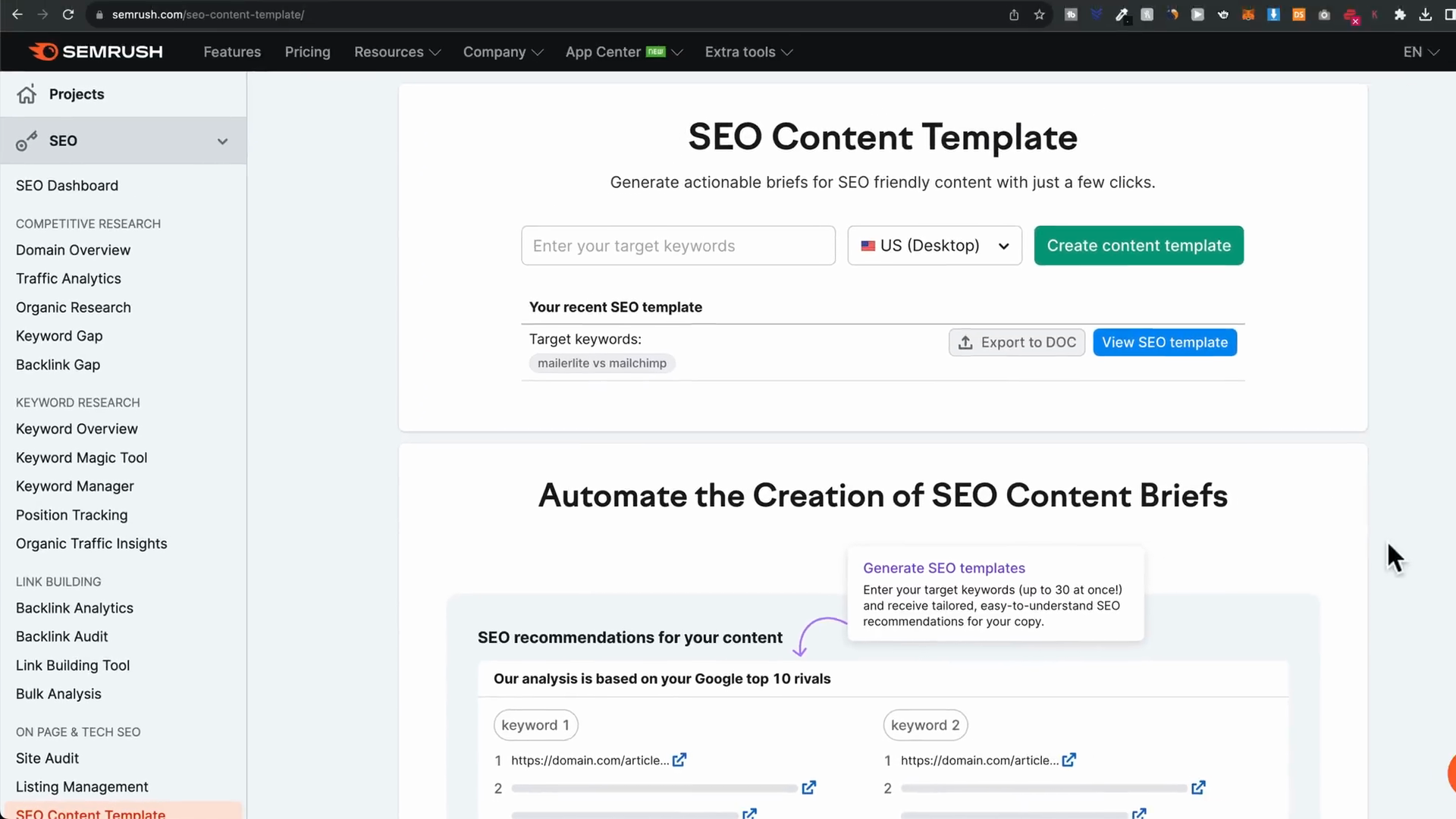
SEO Content Template generates a keyword brief by analyzing the top 10 ranking pages for any target term. Output includes semantically related keywords to include, target word count, readability range, recommended backlinks, and competitor URLs. During testing this saved roughly 45 minutes per brief versus building one manually from SERP scrapes.
ContentShake AI sits one level above as a full content writer. It generates article drafts using real SERP data with built-in SEO recommendations. The output needs editing, but the structure (H2/H3 hierarchy, keyword targets, FAQ block) is solid. We used it to produce a 1,500-word draft on the SaaS test domain in roughly 12 minutes plus 40 minutes of editing. Faster than starting from scratch, slower than Surfer for pure SEO content.
SEO Content Template generates keyword briefs with semantic terms, competitor URLs, and readability targets pulled from the top-ranking pages.
What actually worksPair SEO Content Template with the Writing Assistant Chrome extension. Generate the brief in Semrush, then write directly in Google Docs with live keyword scoring against the brief. The round-trip cuts brief-to-draft time roughly in half.
Site Audit and technical SEO
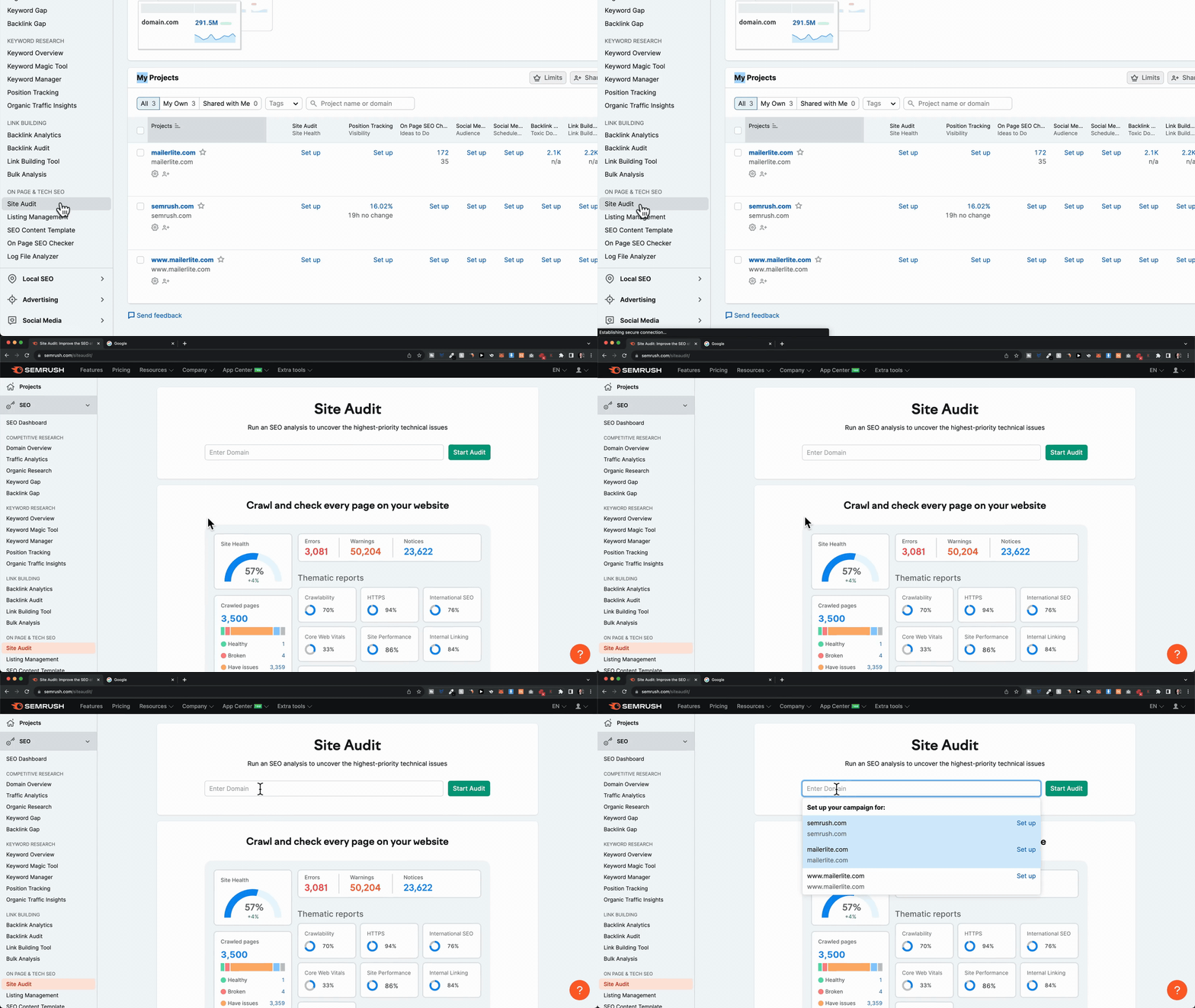
Site Audit is the technical SEO crawler. Point it at a domain, set the crawl size cap, and it returns a prioritized list of broken links, Core Web Vitals issues, missing tags, duplicate content, and crawl errors. The prioritization is the value: issues are ranked by SEO impact (errors, warnings, notices) so you fix what moves rankings first instead of chasing every minor flag.
During testing we ran Site Audit twice on the affiliate test domain (4,449 pages crawled). The second run, after fixing 80 of the flagged errors, lifted the Site Health score from 67% to 82%. The dashboard ties each issue to the affected URL list with one click, which is the small thing that makes the tool actually usable in practice.
Site Audit runs a technical SEO crawl, returning a health score, error counts, and category breakdowns for crawlability and performance.
Semrush vs the alternatives
Semrush vs Ahrefs: Ahrefs has a cleaner interface and is widely considered to have the most accurate backlink data. Semrush wins on feature count, PPC research, and content tools. Most agencies pick Semrush for breadth; link builders often prefer Ahrefs.
Semrush vs Mangools: Mangools at $29/mo is a fraction of the cost and covers basic keyword research and SERP analysis well. If your entire SEO strategy fits in keyword research and rank tracking on one or two domains, start there. When you need site audits, content briefs, and competitor gap analysis in one platform, Semrush is the step up.
Semrush vs Moz Pro: Moz is more beginner-friendly and cheaper at $99/mo, but the keyword database (1.25B vs Semrush's 26B) and feature breadth do not compare. Moz makes sense for learning SEO fundamentals. It does not make sense for serious competitive research at scale.
Semrush pricing
Pro
$139.95/mo
Solo SEOs and freelancers
◆5 projects
◆500 keywords tracked
◆10,000 results per report
◆Keyword Magic Tool, Domain Overview, Site Audit, Position Tracking
◆Backlink Analytics core access
Freelancers and in-house SEOs running one to two domains.
Local SEO add-on:Billed at $50/mo per location for the Pro tier (drops to $40/mo on Guru and Business). One agency managing five client locations adds $200 to $250/mo before the base plan is paid.
.Trends add-on:Traffic Analytics, Market Explorer, EyeOn, and One2Target sit behind a separate $289/mo seat. Required if you want competitive intel beyond the standard Domain Overview.
Agency Growth Kit:Client portal, lead-gen widget, white-label, and CRM cost $69/mo on top of the base plan. Most agencies that buy Semrush eventually buy this too.
Extra user seats:Pro includes 1 user. Each additional seat is $45/mo on Pro, $80/mo on Guru, and $100/mo on Business. A 3-person agency on Guru pays an extra $160/mo for the team.
Pros & cons at a glance
What works
+26+ billion keyword database. The largest commercial dataset; surfaces opportunities competitors using smaller tools miss
+Competitor intelligence is unmatched at this price. Traffic estimates, top pages, ad copy, and backlinks for any domain in seconds
+55+ tools in one login. SEO, PPC research, content, social, and reporting without stitching subscriptions
+Site Audit prioritization is calibrated. Issues are ranked by SEO impact so you fix what matters first
+Daily rank tracking by location and device with clean enough reporting to share directly with clients
+7-day free trial with no credit card and Semrush Academy certifications are free
What doesn't
−$139.95/mo entry is $1,679/year. Real budget commitment for a small business not already generating SEO revenue
−Pro plan limits (5 projects, 500 keywords) bite faster than expected; most users upgrade to Guru within 6 months
−Add-on stack inflates real cost. Local, .Trends, Agency Kit, and seats can double the headline price
−Steep learning curve. Plan 2 to 3 weeks before you find half the tools that should be in your workflow
−Backlink index, while large, still trails Ahrefs for link-data accuracy in our cross-check on three domains
−Traffic data is modeled, not actual. Useful directionally; don't quote it as fact in client decks
How Semrush compares
Feature
Semrush
Ahrefs
Mangools
Moz Pro
Starting price
$139.95/mo
$129/mo (Lite)
$29/mo
$99/mo
Keyword database
26B+
25B+
12B+
1.25B+
Tracked keywords (entry)
500
750
100
300
Site audit
Yes (prioritized)
Yes
Limited
Yes
PPC research
Yes (deep)
Limited
No
No
AI content tools
Yes (ContentShake)
Limited
No
Limited
Best for
Full-stack SEO
Backlink-first SEO
Solo keyword research
Beginners
Ahrefs wins on backlink data and a cleaner UI. Mangools wins on price for solo keyword research. Moz wins for beginners learning fundamentals. Semrush is the only one of the four that bundles SEO, PPC, content, and social into one login at this scale, which is why agencies default to it.
Frequently asked questions
Is the free version usable?
Barely. You get 10 searches per day with limited data. Good for testing the interface, not for real work. Use the 7-day free trial instead if you want a real evaluation.
How accurate is the traffic data?
It's a model based on keyword rankings and CTR estimates, not real clickstream data. Directionally accurate, useful for comparisons. Don't quote it as fact in client decks.
Can I cancel anytime?
Monthly plans yes. Annual plans lock you in for the year but save 17%. Most users start monthly to test, then switch to annual once they commit.
Pro or Guru?
Start with Pro at $139.95/mo. If you hit the 5-project or 500-keyword limits, or you need the Content Marketing Toolkit, upgrade to Guru. Most agencies move within six months.
Is it worth it for bloggers?
Depends on revenue. If your blog earns at least $500/mo from SEO traffic, Pro at $139.95/mo pays for itself on one ranked content cluster. If it's a hobby blog, Mangools at $29/mo covers what you need.
Does Semrush replace Ahrefs?
For most SEO use cases, yes. The exception is backlink-heavy work where Ahrefs is still the practitioner default. Many agencies run both, using Semrush for keyword research, audits, and content, and Ahrefs for link analysis.
FINAL ENTRY · THE BOTTOM LINE
If SEO is a core growth channel and you use the full platform (keyword research, audits, rank tracking, content briefs, competitor research), Semrush pays for itself. If you only need keyword research or run one low-volume blog, Mangools or Ubersuggest do the job for a fraction.