
GoHighLevel vs HubSpot 2026: The Operator's Decision Framework
HubSpot wins on CRM depth, attribution, and HIPAA. GoHighLevel wins on price, multi-channel automation, and white-label revenue. Here is the honest 2026 verdict, with both migration runbooks.

By Rachel Dowd, Senior Editor
Published January 2026 · · ● reading now

Disclosure: Some links in this article are affiliate links. We may earn a commission at no extra cost to you.
You are paying $800 a month for HubSpot Marketing Hub Professional and using maybe 30% of it. Or you are paying $97 a month for GoHighLevel and bumping into limitations every other week. Either way, you opened this comparison because the bill is bigger than the value you are extracting, and the feature list on each vendor's site is not telling you which one is wrong for your business.
This article is the version I wish I had when an agency client asked me to spec their CRM stack last quarter. It covers actual 2026 pricing, the compliance gap that disqualifies one platform for healthcare clients, the migration runbook in both directions, and the business-model matrix that resolves which tool wins for which buyer. I am Rachel Dowd, Senior Editor at Ea-Nasir.co, and my job here is not to sell you GoHighLevel. My job is to tell you when GoHighLevel loses, so the rest of the recommendation has weight.
The 60-second verdict
TL;DR
For agencies, coaches, and local service businesses under $5M revenue, GoHighLevel wins on price ($97 to $497/mo vs $800 to $3,600/mo for HubSpot), wins on multi-channel automation, and wins on the white-label revenue model. HubSpot wins on CRM depth, attribution reporting, and HIPAA support on Enterprise. Choose by business model, not feature checklist.
At-a-glance pricing comparison
| Tier | HubSpot Marketing Hub | GoHighLevel |
|---|---|---|
| Starter | $20/mo (1,000 contacts, no automation workflows) | $97/mo (unlimited contacts, full automation, SMS, voice, funnels) |
| Pro | $800/mo (Marketing Pro, 2,000 marketing contacts) | $297/mo (white-label, unlimited sub-accounts, SaaS Mode) |
| Enterprise-equivalent | $3,600/mo (Marketing Enterprise) plus Sales Hub Pro at $450/mo | $497/mo (SaaS Pro, includes AI Employee, premium triggers) |
The price spread is not a 2x or 3x difference. At Pro tier it is roughly 2.7x. At the entry-to-Pro jump it is 8x. That gap pays for HubSpot's integration depth, reporting suite, and brand recognition. Whether that gap is worth paying depends entirely on your business model. For an agency reselling the platform to 15 clients, the answer is no. For a 200-person B2B sales team running multi-touch attribution into a CFO dashboard, the answer is yes.
The rest of this article unpacks why the verdict resolves cleanly once you know which buyer you are. I will not tell you GoHighLevel is the answer for everyone. It is not. There are five buyer profiles where HubSpot is genuinely the right call, and I will name them.
Pricing reality 2026
Both vendors publish their pricing publicly, which is rare and helpful. The trap is not the headline number. The trap is the add-on stack.
HubSpot Marketing Hub tiers and contact pricing
Per the HubSpot Marketing Hub pricing page, the 2026 tiers are: Free (limited to 2,000 email sends/month, no automation), Starter at $20/month (1,000 marketing contacts, removes HubSpot branding, still no workflows), Professional at $800/month (2,000 marketing contacts, full automation, A/B testing, custom reporting), and Enterprise at $3,600/month (10,000 marketing contacts, custom objects, predictive lead scoring, revenue attribution).
The "marketing contacts" distinction matters. HubSpot separates contacts you actively market to from passive records. You pay per marketing contact above the tier limit. At Professional, additional marketing contacts run roughly $250 per 5,000 contacts. An agency or B2B firm that crosses 10,000 marketing contacts on Pro tier is paying $800 plus another $400+ in contact overage. The published $800/mo is the floor, not the steady-state cost.
GoHighLevel Starter, Pro, and SaaS Pro
The GoHighLevel pricing page lists three tiers in 2026: Starter at $97/month (one location, full CRM, automation, SMS/voice/email, booking calendar, funnel builder, courses, reputation management, unlimited contacts), Pro/Agency at $297/month (everything in Starter plus unlimited sub-accounts, white-label, branded mobile app, API access, SaaS Mode), and SaaS Pro at $497/month (Pro features plus AI Employee, premium workflow triggers, advanced reseller tooling).
The notable feature is unlimited contacts at every tier. There is no contact-based pricing escalation in GHL. A solo coach with 800 contacts and an agency with 80,000 contacts pay the same $97 base on Starter (or $297 on Pro). For high-volume list owners, that pricing model alone is the deciding factor.
Hidden costs (10DLC registration, Twilio passthrough, HubSpot Sales Hub stacking)
Both platforms have passthrough costs that the headline pricing does not include. For US SMS, both require 10DLC brand and campaign registration through The Campaign Registry, which runs $4 per brand registration plus $10/month per campaign at the Standard tier. SMS messages on GHL are billed via Twilio passthrough at roughly $0.0083 per outbound segment. A 5,000-message-per-month SMS campaign adds about $42 in carrier fees on top of your platform subscription.
HubSpot does not natively run SMS. To get SMS on HubSpot you bolt on a third-party tool like Sakari or SimpleTexting at $59 to $99/month, which itself charges per-message rates similar to Twilio. So HubSpot's "true" SMS-capable cost adds $60+ to whatever Marketing Hub tier you are on.
The other HubSpot stacking trap is Sales Hub. The Marketing Hub Pro at $800/mo does not include Sales Sequences, calling tools, deal forecasting, or playbooks. To get those you add Sales Hub Professional at $450/month. CMS Hub for branded landing pages is another $400+/month at Pro tier. A real-world HubSpot stack for a 10-person team often lands at $1,250 to $1,650/month before contact overages.
12-month TCO for a 20-client agency
Here is the honest annual math for a digital marketing agency running 20 active clients with email, SMS, calling, booking, and pipeline management.
HubSpot stack: Marketing Hub Pro $800 + Sales Hub Pro $450 + Sakari SMS integration $79 + CMS Hub Starter $25 = $1,354/month. Twelve months: $16,248.
GoHighLevel stack: Pro tier $297 + estimated $40/month in SMS passthrough across 20 clients = $337/month. Twelve months: $4,044.
Annual difference: $12,204. That is a junior employee, an offshore VA team, or a $1,000/month software budget for the next year. The TCO comparison is not subtle.
Pricing Caveat
If your business depends on revenue attribution reporting (multi-touch, channel-level, cohort-level) for board reporting, the $12k/year HubSpot premium is a feature you are buying, not waste. Read the reporting section before deciding.
CRM depth and contact records
HubSpot wins this section. I will say that early so the rest reads cleanly.
Contact record structure
HubSpot's contact record is the gold standard for B2B CRM data structure. A single contact record aggregates: every page view on your site (with timestamps and time-on-page), every form submission, every email sent and opened, every meeting booked, every call logged, every note added by any rep, and every association with companies and deals. Custom properties extend this with whatever fields your sales process requires. The Universal Inbox folds email, chat, and form submissions into one timeline view. For a complex B2B sale with a 6-month cycle and five stakeholders, this depth is real and useful.
GoHighLevel's contact record covers the practical 80%: name, contact methods, conversation history (SMS, email, voice, Facebook DM, Instagram DM), pipeline stage, custom fields, tags, tasks, and notes. What it does not do is associate contacts to multi-entity company records the way HubSpot does. There is no "company" object that links to multiple contacts with role data and parent-child company relationships in the way HubSpot supports. For service businesses talking to one decision-maker per account, this is fine. For B2B sales with 5+ buying-committee stakeholders per account, it is a real gap.

Deal pipeline and forecasting
HubSpot's deal pipeline supports deal stages, stage probabilities, automated stage transitions, deal-based reporting, and forecasting models that account for deal age, velocity, and probability-weighted revenue. Sales Hub Pro adds Sales Sequences (multi-touch outreach automation tied to deal stage), playbooks, and revenue forecasting that closes the loop with HubSpot's reporting suite.
GoHighLevel's pipeline is visual and functional, with drag-and-drop stage management and value tracking per opportunity. Forecasting is limited. There is no probability-weighted revenue model, no deal velocity reports, no sales sequence engine tied to pipeline. For agencies tracking client acquisition (where the "deal" is a service contract), GHL is sufficient. For 30-rep B2B sales orgs with quarterly forecasting calls, it is undercooked.
Custom properties and objects
HubSpot Pro includes custom contact, company, and deal properties. HubSpot Enterprise unlocks custom objects, which let you model entities that do not fit contact/company/deal (think: subscriptions, properties, vehicles, anything industry-specific). Custom objects are a legitimate enterprise feature that GHL does not match.
GoHighLevel allows custom fields on contacts and opportunities, and custom values for use in templates and workflows. There is no equivalent to HubSpot custom objects. If your business model requires modeling assets, subscriptions, or non-contact entities in the CRM, GHL will require a workaround (usually a third-party database or Airtable bridge).
Where each falls short
HubSpot's CRM depth comes with HubSpot's pricing. To get custom objects you need Enterprise at $3,600/month. To get Sales Sequences you add $450/month for Sales Hub Pro. The depth is real, but you are paying $1,250+/month minimum to access it.
GoHighLevel's CRM depth caps at the agency-managing-service-clients use case. The visual pipeline, conversation history, and task system handle service business workflows cleanly. Multi-stakeholder B2B deals with parent-child account structure, custom objects, and probability-weighted forecasting are not what GHL is built for. Trying to force it is a sign you should be on HubSpot, Salesforce, or Close.
Automation and multi-channel workflows
This is GoHighLevel's territory. The automation engine is the reason agencies switch off HubSpot.
HubSpot workflows: native channels and limits
HubSpot Workflows (available from Marketing Hub Pro at $800/mo) is a strong visual workflow builder. You can trigger automations on contact properties, form submissions, deal stages, page visits, email engagement, list membership, and CRM events. Branching logic is clean. The native action library covers send email, update property, enroll in sequence, create task, notify rep, set deal stage, add to list, and rotate ownership.
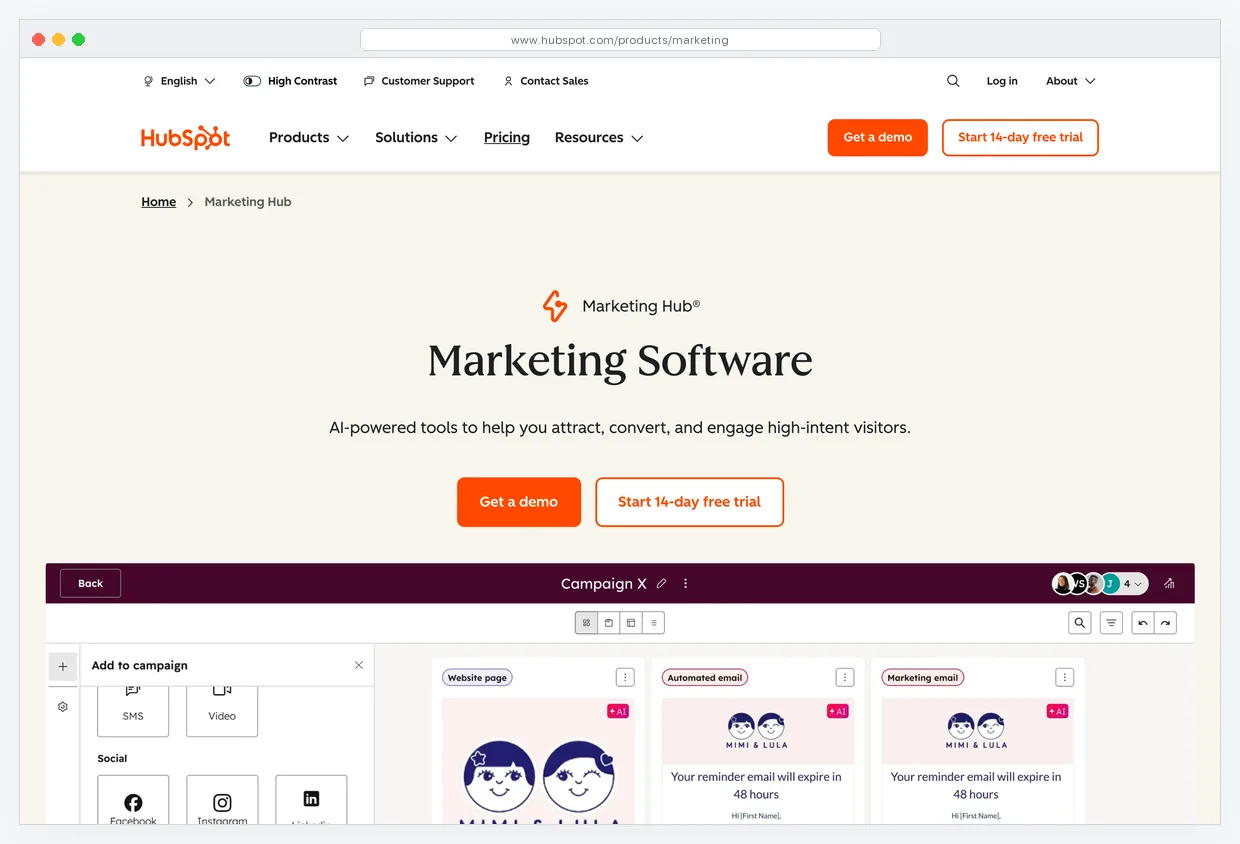
The limit is channel depth. HubSpot natively automates email, in-app actions, and Slack/Teams notifications. SMS is not native. Voice calls and ringless voicemail are not native. WhatsApp messaging requires an Enterprise tier integration. Facebook Messenger is supported via the Inbox but not as a workflow action. The platform was built around email as the primary channel and the workflow engine reflects that DNA.
GoHighLevel workflows: SMS, voice, email, voicemail in one editor
GoHighLevel's workflow builder ships with native action nodes for SMS, MMS, email, voice calls (inbound and outbound), ringless voicemail drops, Facebook Messenger, Instagram DM, GBP Messages, and webhook calls. A single workflow can run a multi-channel sequence like: trigger on form fill, send SMS in 60 seconds, send email at 30 minutes, drop voicemail at day 1, attempt automated outbound call at day 3, send follow-up SMS at day 5, and create a task for a human rep at day 7.

This is not a marginal HubSpot improvement. It is a different category. For service businesses where speed-to-lead matters (lead density follows a power-law decay curve where contacting a lead in under 5 minutes yields a 9x higher conversion than 30 minutes), the ability to fire SMS in seconds inside a single platform changes the conversion math materially.
Branching logic and conditional triggers
Both platforms support if/then branching with multiple conditions. HubSpot's branching is more structured (if/else with property comparisons, list membership, deal stage). GHL's branching is more flexible but the UI is busier (multiple condition types, custom values, math operations on field values).
The practical difference: HubSpot enforces structure that scales cleanly to teams of 20+ marketers. GHL gives you more rope and trusts you not to hang yourself with it. For a solo operator or a 3-person agency team, GHL's flexibility wins. For a 30-marketer org with workflow governance requirements, HubSpot's structure prevents chaos.
Trigger volume and execution speed
HubSpot Pro tier includes 1,000 active workflows. Enterprise includes 1,200. Workflow execution is reliable and the system handles high-volume triggers without queueing issues at typical mid-market scale.
GoHighLevel does not publish a hard workflow cap on Pro tier. Sub-accounts can run dozens of workflows in parallel. Execution speed for SMS sends is sub-30-seconds in practice. For high-volume agencies running automation across 20+ sub-accounts simultaneously, GHL holds up. The known weakness is workflow execution under heavy concurrent load (1,000+ contacts triggering at once); occasional delays of 2 to 5 minutes happen but are rare.
AI features: Conversation AI vs Breeze
Both platforms launched AI features in 2024 and refined them through 2025 and 2026. The capability gap is narrower than the marketing pages suggest.
GoHighLevel Conversation AI and Workflow AI
GoHighLevel's AI suite in 2026 includes Conversation AI (auto-replies to inbound SMS and Messenger conversations using a custom-trained agent), Voice AI (handles inbound calls with a custom AI receptionist), Workflow AI (generates and modifies workflow templates from natural-language prompts), and Content AI (generates email copy, landing page sections, and SMS scripts). At the SaaS Pro tier ($497/mo), GHL adds AI Employee features that bundle these capabilities into a sellable client offering.
Pricing model: Conversation AI and Voice AI are usage-billed (roughly $0.02 to $0.05 per message processed, $0.13 per minute of AI voice). The platform tier covers the engine; the per-use costs are passthrough. For a 1,000-conversation-per-month inbound flow, expect $20 to $50/month in AI usage on top of subscription. The detailed breakdown is in the GoHighLevel AI features article.
HubSpot Breeze and Breeze Copilot
HubSpot Breeze (rebranded from ChatSpot in 2024) covers Breeze Copilot (in-product AI assistant for content generation and CRM queries), Breeze Agents (autonomous AI for prospecting, content writing, and customer service), and Breeze Intelligence (data enrichment from a 200M+ contact database). Available on HubSpot tiers from Starter, with feature depth scaling by tier.
Pricing model: Breeze Copilot is included in all paid HubSpot tiers. Breeze Agents are usage-billed credits, and Breeze Intelligence is a separate add-on starting at roughly $30/month for 100 credits. The cost stacking is real and worth modeling carefully. The full pricing breakdown is in the HubSpot Breeze pricing 2026 article.
What you actually pay for AI on each
For a real-world use case (AI-powered inbound SMS reply for 500 conversations/month, plus AI content generation for marketing emails), the comparison lands roughly at: GHL adds about $25/month in passthrough AI usage on top of the platform tier. HubSpot's Breeze Copilot is included on Pro tier with the AI agents adding $50 to $200/month in credits depending on usage volume.
The honest assessment: Breeze's content generation is more polished. GHL's Conversation AI is more functional out-of-the-box for inbound message handling. Neither platform wins decisively on AI capability alone. Pick on platform fit, not AI feature parity.
Integrations and API access
HubSpot App Marketplace (1,400+ apps)
HubSpot's App Marketplace lists 1,400+ certified integrations, including deep native connectors for Salesforce, Slack, Zoom, Microsoft Teams, Stripe, Shopify, WordPress, Mailchimp (for migrations), and the entire Google Workspace and Microsoft 365 stack. Salesforce sync alone is bidirectional, field-level configurable, and handles deduplication cleanly. For an organization where multiple SaaS tools must speak to the CRM with low latency, HubSpot is functionally the only option in this price range.
GoHighLevel native integrations and API
GoHighLevel's native integration list is shorter but covers the operational essentials for service businesses: Stripe for payments, Mailgun and SMTP for transactional email, Twilio for SMS and voice, Facebook and Instagram for messaging and ads, Google My Business, QuickBooks, and a growing set of marketplace integrations. The HighLevel API is REST-based with documented endpoints for contacts, opportunities, conversations, and workflows. API access is included on the Pro tier and above.
The gap is enterprise depth. There is no Salesforce native integration. There is no SAP connector. Integration with anything outside the marketing-and-sales-tooling ecosystem requires Zapier, Make, or custom API work.
Zapier and Make as the bridge for both
Both platforms have first-party Zapier and Make integrations. Zapier supports 50+ HubSpot triggers and actions and 30+ GHL triggers and actions. Make has similar coverage. For 80% of "I need to connect X to my CRM" use cases, Zapier or Make is the answer regardless of which platform you choose.
The break-point is when Zapier latency or per-task pricing becomes a problem. A workflow that fires 10,000 times per month on Zapier costs roughly $73/month at the Professional tier. The same volume native-to-HubSpot is included in your platform fee. For high-volume integration paths, native HubSpot wins. For occasional low-volume connections, both platforms are equivalent via Zapier.
One integration footnote worth flagging: agencies running a funnel-first stack often pair HubSpot with a dedicated funnel builder like ClickFunnels for landing pages and order forms, then sync to HubSpot via Zapier. GHL's native funnel builder covers most of that scope inside the platform, which is part of the consolidation argument. If you are weighing whether to keep a separate funnel tool or move it inside your CRM, the ClickFunnels review covers the trade-offs in depth.
Compliance: TCPA, 10DLC, GDPR, HIPAA
This is the section where one of the platforms gets disqualified for entire industries. Read carefully.
TCPA and 10DLC for US SMS (required for both)
Any business sending SMS to US recipients in 2026 must register their brand and campaigns through The Campaign Registry for 10DLC compliance. This is not optional. Unregistered traffic is filtered or blocked by US carriers. The registration process costs $4 per brand plus $10/month per Standard campaign.
Both GHL and HubSpot (via Sakari or SimpleTexting) handle 10DLC registration as part of their SMS onboarding. Both platforms support the consent capture and opt-out handling required by the TCPA and the CTIA Messaging Principles. Functional parity here.
The practitioner-level difference: GHL's SMS compliance tooling is built into the platform with consent fields, opt-out keyword handling (STOP, UNSUBSCRIBE, REMOVE), and automatic suppression list management. HubSpot's SMS compliance depends on which third-party SMS integration you bolt on. Sakari handles this well. Some smaller integrations do not.
GDPR consent and EU readiness
HubSpot ships GDPR-ready consent banners, double opt-in workflows, lawful basis tracking, and right-to-be-forgotten automation for any contact record. The GDPR tooling is documented, audit-ready, and used by thousands of EU-based HubSpot customers without issue.
GoHighLevel supports GDPR consent capture via custom fields and forms, and supports right-to-be-forgotten through the contact deletion API. The tooling is functional but less polished. For EU-based businesses, GHL works but you should expect to do more configuration work yourself.
HIPAA: HubSpot Enterprise option vs GHL's gap
HubSpot supports HIPAA on Enterprise tier with a signed Business Associate Agreement (BAA). The supported features include CRM, email, and limited workflow scope. The full eligible feature list is documented in HubSpot's HIPAA support documentation. For healthcare practices, telehealth providers, and any organization handling Protected Health Information (PHI), HubSpot Enterprise with a BAA is a viable platform.
GoHighLevel does not offer a HIPAA BAA at any tier in 2026. If you handle PHI, GHL is not a compliant choice. There are workarounds (segregating PHI in a separate HIPAA-compliant system and using GHL only for non-PHI marketing), but using GHL as your primary CRM for a healthcare practice exposes you to HIPAA violations. This is the single hardest disqualifying factor in the comparison.
Compliance Disqualifier
If your business handles PHI (medical practices, mental health, telehealth, dental, chiropractic with health intake), GoHighLevel is not an option. Use HubSpot Enterprise with a BAA, or a HIPAA-native CRM like Healthie or Practice Better. Do not let the price comparison override this.
SOC 2 status and audit logs
HubSpot maintains SOC 2 Type II certification, ISO 27001 certification, and publishes audit logs at the Enterprise tier. For procurement teams at mid-market and enterprise companies that require SOC 2 evidence in vendor reviews, HubSpot ships the documentation.
GoHighLevel's security posture is improving but the public certification list is shorter. For agency clients in regulated verticals or enterprise procurement processes, expect to provide additional vendor questionnaires when GHL is the proposed CRM.
Reporting and attribution depth
HubSpot wins this section cleanly. I will explain why and then explain when that win actually matters.
HubSpot multi-touch attribution and revenue reporting
HubSpot Marketing Hub Pro includes multi-touch attribution reporting that traces revenue to first-touch, last-touch, linear, time-decay, and U-shaped attribution models. Custom dashboards combine deal data, contact data, marketing data, and product usage data into a single board-ready view. Revenue attribution by channel (organic, paid, email, social, referral) is calculated automatically. Funnel analytics and deal velocity reporting are included at Pro tier.
For a B2B company presenting quarterly performance to a board or investor group, this reporting is genuinely useful. The data is structured, exportable to Excel and Google Sheets, and pipes natively to Looker via the HubSpot Looker connector.
GoHighLevel dashboards and the reporting depth gap
GoHighLevel ships solid operational dashboards: pipeline value by stage, conversion rates by stage, opportunity volume by source, appointment booking rates, conversation response times, and SMS/email engagement metrics. For day-to-day operating decisions, GHL's reporting is sufficient.
What is missing: multi-touch attribution, cohort analysis, revenue-by-marketing-channel calculations that account for assist credit, and any concept of probability-weighted revenue forecasting. The reporting suite is built for "is the business running" rather than "what should we tell the board about Q3 marketing performance."
Exporting to Looker, Tableau, or a warehouse
HubSpot offers native connectors to Looker, Tableau, and PowerBI on Enterprise. CSV export from any report at Pro tier. Webhooks and API access support pushing data to Snowflake, BigQuery, or any warehouse with custom ETL.
GoHighLevel offers CSV export on opportunities, contacts, and conversations. Webhooks and API access on Pro tier support pushing data to a warehouse with custom ETL, but there is no native Looker or Tableau connector. If your analytics stack lives in a warehouse and your CFO consumes dashboards in Looker, HubSpot is the easier path.
White-label and agency revenue
This section ends the comparison for any agency owner reading it.
GHL SaaS Mode revenue math
GoHighLevel at $297/month (Pro tier) includes SaaS Mode: white-label the entire platform under your own brand and resell it to clients as your proprietary software. You set the pricing. You keep the margin. GoHighLevel bills you $297/mo flat and you bill clients whatever you want for access to your branded app.
Realistic agency model: 15 clients at $297/mo each on your branded platform = $4,455/mo recurring revenue. Your platform cost is $297/mo. Net margin before delivery costs: $4,158/mo, or roughly $50,000/year of recurring SaaS-style revenue layered on top of your services revenue. Scale to 30 clients at $297/mo and you are at $8,910/mo gross with the same $297/mo platform cost.
The economics break down cleanly: every client added to your white-labeled platform increases revenue by $297 (or whatever you charge) at zero incremental platform cost. The platform is fixed. The revenue is variable. This is the agency revenue line that does not exist in HubSpot's universe.
Sub-account structure (one per client)
GHL Pro tier includes unlimited sub-accounts. Each client gets their own isolated sub-account with their own contacts, workflows, calendars, and pipelines. You manage all sub-accounts from a single agency dashboard. Account-level templates let you snapshot a working setup and clone it across new client onboardings, which compresses onboarding from days to hours.
Sub-account isolation is genuine. Client A's contacts are not visible to Client B. Permissions are configurable per sub-account. White-label branding can be customized at the sub-account level (different logos, color schemes, custom domains) so each client experiences your platform as their own.
HubSpot Solutions Partner Program (the closest equivalent, and why it isn't the same)
HubSpot's Solutions Partner Program is the closest thing HubSpot offers for agencies. Partners earn commission on HubSpot subscriptions sold to their clients (typically 10-20% recurring), get access to partner training and certifications, and can manage multiple client accounts from a single partner portal.
What the Solutions Partner Program is not: a white-label of HubSpot. Clients see "HubSpot." Clients pay HubSpot directly. Clients can fire you and keep their HubSpot. The agency is a referral and management layer, not a software reseller. For an agency that wants HubSpot's CRM depth and is comfortable with the referral commission model, this works. For an agency that wants to own the client relationship and brand the software as theirs, HubSpot does not solve this.
Practitioner Tip
If you are evaluating GHL specifically for the white-label revenue model, do the unit economics math first. Average client price ($297/mo is a common starting point), churn rate (assume 4-6% monthly for typical agency clients), and acquisition cost per client. The model works at scale. It does not work as a side project.
Choose by business model
The right tool depends on what business you are running. Here is the verdict matrix.
| Business model | GHL fit | HubSpot fit | Verdict |
|---|---|---|---|
| Agencies (5-50 clients) | Strong. White-label, sub-accounts, multi-channel automation | Weak. No white-label, expensive, partner program is referral-only | GoHighLevel |
| Local service businesses | Strong. Booking, SMS, voice, reputation, follow-up automation | Weak. Overpriced, missing native SMS/voice/booking | GoHighLevel |
| B2B SaaS startups (1-15 employees) | Moderate. Adequate CRM, weak on enterprise integrations | Strong. Free CRM scales, integration depth, reporting | HubSpot |
| Ecommerce | Moderate. Funnels, abandoned cart SMS, but Shopify integration is shallow | Strong. Native Shopify, deep ecom-specific reporting | Hybrid |
| Regulated industries (healthcare, financial) | Weak. No HIPAA BAA | Strong. HIPAA on Enterprise, full GDPR, SOC 2 | HubSpot |
| Enterprise RevOps | Weak. No Salesforce sync, limited custom objects | Strong. Multi-touch attribution, Salesforce sync, audit logs | HubSpot |
Agencies
For agencies serving 5 to 50 clients, GoHighLevel is the practical winner. The white-label model is a revenue driver, sub-account isolation gives you client-side data hygiene, and the multi-channel automation matches what most agency clients expect from "a marketing platform." HubSpot's Solutions Partner Program does not provide the same revenue model. The TCO gap is meaningful at agency scale.
Local service businesses
Plumbers, HVAC, dentists (non-PHI marketing), home services, fitness studios, salons. The job-to-be-done is "respond to inbound leads in under 5 minutes, book the appointment, send reminders, request the review." GHL's native booking calendar, SMS reminders, voice calling, and reputation management do this in one platform. HubSpot does not.

B2B SaaS startups
For a 1-15 person B2B SaaS startup with a free trial funnel, integration with their product, and a need to scale to mid-market, HubSpot's free CRM with eventual upgrade to Marketing Hub is the cleaner path. The Salesforce sync option matters when an enterprise prospect requires it. The reporting suite supports investor metrics. GHL is functional but you will outgrow it on the integration depth side at Series A.
Ecommerce
For a Shopify-based brand running abandoned cart, post-purchase, and lifecycle email plus SMS, both platforms work. HubSpot's Shopify integration is deeper for product catalog sync and revenue attribution. GHL's funnel builder and SMS automation are stronger for direct-response style campaigns. Many ecom brands run HubSpot as the analytics layer and a tool like Klaviyo or Postscript for the email/SMS execution. GHL is a viable consolidation play if you want to ditch Klaviyo and Postscript and run everything in one platform.
Regulated industries
Healthcare, telehealth, financial services. HubSpot Enterprise with a BAA. GHL is not an option for the primary CRM. Mental health practices, dental offices with health intake forms, telehealth providers, and any business handling PHI must choose a HIPAA-compliant platform. Do not negotiate this.
Enterprise RevOps
Multi-touch attribution requirements, Salesforce sync, 50+ user team, SSO, audit logs. HubSpot Enterprise. GHL was not designed for this buyer and trying to force it creates more problems than it solves.
Migration playbook (both directions)
Migration is the second-most-common reason readers email me. Here is the runbook for both directions.
HubSpot to GoHighLevel: the runbook
- Export contacts from HubSpot via Settings > Import & Export. Choose CSV format. Include all custom properties as columns.
- Export deals (opportunities) from HubSpot. Note the deal stage labels exactly as they appear in HubSpot.
- In GHL, create a new sub-account or location for the migrating company.
- Recreate custom contact fields in GHL Settings > Custom Fields to match the HubSpot custom property structure.
- Recreate pipelines and stages in GHL Opportunities > Pipelines, mapping HubSpot deal stages to GHL pipeline stages.
- Import contacts via Bulk Actions > Import Contacts. Upload the HubSpot CSV. Map columns to GHL custom fields explicitly.
- Import deals/opportunities via the Opportunities import. Map deal stage values to your new pipeline stages.
- Recreate email templates, SMS templates, and snippets in GHL.
- Rebuild workflows in GHL. The structure does not migrate. Plan to spend 2 to 5 days rebuilding the most critical 10 to 20 automations.
- Reconnect integrations: Stripe, Mailgun for email, Twilio for SMS (provisioning new numbers and registering 10DLC).
- Run parallel for 14 to 30 days. Keep HubSpot read-only. New activity flows to GHL only.
- Decommission HubSpot once you confirm 30 days of clean data in GHL with no migration artifacts.

GoHighLevel to HubSpot: the runbook
- Export contacts from GHL Bulk Actions > Export. CSV format with all custom field columns.
- Export opportunities from GHL Opportunities > Export. Note pipeline names and stage labels.
- In HubSpot, set up a new account or new portal for the migrating company.
- Create custom contact properties in HubSpot Settings > Properties to match GHL custom fields.
- Recreate deal pipelines and stages in HubSpot Settings > Objects > Deals.
- Import contacts via HubSpot Import tool. Map GHL CSV columns to HubSpot properties explicitly.
- Import deals via the deal import. Match GHL pipeline stages to HubSpot deal stages.
- Recreate email templates and sequences in HubSpot. Note that GHL's multi-channel automations will not have direct HubSpot equivalents. SMS will require a Sakari integration.
- Rebuild workflows in HubSpot. Build email-only workflows in HubSpot's workflow editor. Move SMS automations to your chosen SMS integration.
- Reconnect integrations. HubSpot's Salesforce, Slack, Zoom, and Stripe connectors are native. Set up Sakari or SimpleTexting for SMS continuity.
- Run parallel for 30 days. Keep GHL read-only. New activity flows to HubSpot only.
- Decommission GHL once HubSpot is the source of truth.
Data you will lose either way
Migration Data Loss Warning
Both directions, plan to lose: full conversation history threading (SMS and email threads do not import cleanly), historical workflow execution logs (you will not see what automations ran on a contact in 2024), call recordings older than 90 days, deal stage history timestamps (you will see current stage, not the path), and any analytics data older than the export date.
The honest expectation is that contact data, deal data, and custom fields migrate cleanly. Everything else (timeline data, automation history, analytics data) is essentially lost. Plan accordingly. Most agencies treat migration as "Day 0" of new platform usage and accept that historical analytics will not be queryable in the new system.
When HubSpot is genuinely the right call
I have spent most of this article making the case for GHL. To balance the analysis, here are the five buyer profiles where HubSpot is the right answer and I would not recommend GHL.
Salesforce-integrated organizations. If your company runs Salesforce as the system of record and your marketing CRM must sync bidirectionally with Salesforce contacts, accounts, and opportunities, HubSpot's Salesforce integration is the best in the market and there is no GHL equivalent. The integration handles deduplication, field mapping, and sync conflict resolution at a level GHL does not approach. For RevOps teams that need this, the price difference is irrelevant.
Regulated industries needing HIPAA BAA. Healthcare, telehealth, mental health, dental practices with health intake. HubSpot Enterprise with a signed BAA is the compliant path. GHL has no HIPAA BAA in 2026. If you handle PHI, HubSpot is your only viable option in this comparison.
Multi-touch attribution requirements. If your CFO or board demands marketing attribution by channel with first-touch, last-touch, and time-decay models for quarterly reporting, HubSpot Pro and Enterprise ship this out of the box. GHL does not have an equivalent. Building this in GHL requires custom data pipelines and external BI tools, which is more expensive than HubSpot's Pro tier in practice.
Dedicated content team using HubSpot's CMS Hub. If you have a content marketing team running 50+ blog posts a month, multiple landing pages, and a knowledge base, HubSpot CMS Hub at $400+/mo is a genuinely strong content platform. The GHL funnel builder and blog functionality is functional but not at HubSpot's level for content-heavy operations. WordPress with the right setup is also stronger than GHL for content. If content is your acquisition channel, evaluate HubSpot CMS or WordPress, not GHL.
Large sales team needing forecasting depth. A 30+ rep B2B sales team running probability-weighted forecasting, deal velocity tracking, and sales sequence automation. HubSpot Sales Hub Pro plus Enterprise reporting is built for this. GHL's pipeline is sufficient for service businesses where the deal is a contract sale, but it is not built for complex multi-stakeholder enterprise selling.
If any of those five describe your situation, do not buy GoHighLevel because of price. Buy HubSpot because of fit. The cost is the cost of the right tool, and the wrong tool is more expensive over a year.
Final verdict
Here is where I have to be honest about GoHighLevel's flaws before I give you the affiliate link, because if I drop the link without naming the limitation, the whole framework collapses.
GoHighLevel has a real learning curve. The UI is busier than HubSpot's. There are more menu options, more configuration toggles, and more places to break something with a bad workflow setting. The platform is built for power users who want flexibility, not for first-time CRM buyers who want guardrails. Expect a 2 to 4 week learning curve to get comfortable. Expect occasional friction with the UI when you are deep in workflow editing. The reporting depth is not at HubSpot's level. Customer support response times have improved in 2025-2026 but are still slower than HubSpot's enterprise support. Those are real limitations and they should not be glossed over.
With that said, for the buyer profiles this article was written for (agencies, local service businesses, coaches, consultants, and operators under $5M with multi-channel sales processes), the per-client revenue math, the white-label model, and the multi-channel automation engine resolve the comparison cleanly. The TCO gap of $12,000+ per year vs HubSpot Pro pays for the learning curve many times over.
My Recommendation
For agencies, local services, coaches, and operators under $5M with active multi-channel sales: Start with GoHighLevel ($97/mo). Run the 14-day trial in parallel with your current stack. If the learning curve sticks and the automation engine matches your workflow, upgrade to Pro at $297/mo and start the white-label revenue model. For HIPAA, Salesforce-integrated, or attribution-heavy buyers, choose HubSpot.
If you are not sure which buyer profile you fit, the AI recommendation engine at /ai-tools walks through 10 questions about your business model, compliance needs, and sales motion, and returns a tool match with reasoning. Use it before you commit. The cost of switching CRMs in year 2 is bigger than the cost of taking 30 minutes to choose correctly in year 1.
For the deeper feature breakdowns referenced throughout, read the GoHighLevel review, the HubSpot review, the GoHighLevel true cost analysis, and the HubSpot alternatives 2026 guide. For comparisons against other GHL competitors, see GoHighLevel vs Kartra and GoHighLevel alternatives. For coach-specific guidance, the best CRM for coaches and consultants article walks the decision in coach-specific terms. For broader small-business CRM context, see CRM tools for small business 2026. For an external buyer-side benchmark, the G2 GoHighLevel vs HubSpot comparison aggregates user reviews from both platforms.
Frequently asked questions
Which is cheaper, HubSpot or GoHighLevel, after add-ons?
GoHighLevel is meaningfully cheaper for most use cases. Real-world example: a 20-client agency stack on HubSpot (Marketing Hub Pro $800 + Sales Hub Pro $450 + SMS integration $79 + CMS Hub $25) lands at $1,354/month. The same coverage on GoHighLevel Pro is $297/month plus roughly $40 in SMS passthrough, so $337/month. Annual difference: about $12,200. The exception is if you only need HubSpot's free CRM and basic email, in which case HubSpot Free is cheaper than GHL Starter. For any business needing automation and multi-channel outreach, GHL wins on price.
Can I migrate from HubSpot to GoHighLevel without losing my contact history?
Contact data and deal data migrate cleanly via CSV export and import. Custom properties map to custom fields. Pipeline stages transfer with manual mapping. What does not migrate cleanly: full conversation threading (SMS and email thread continuity is broken), historical workflow execution logs, call recordings older than 90 days, and analytics data older than your export date. Plan for 2 to 5 days to rebuild your most important 10 to 20 workflows. Run parallel for 14 to 30 days before decommissioning HubSpot. Most agencies treat migration as "Day 0" of new platform usage and accept the historical data gap.
Can I migrate from GoHighLevel to HubSpot if I outgrow it?
Yes, and the path is symmetric. Export contacts and opportunities from GHL as CSV. Recreate custom properties and pipelines in HubSpot. Import. Rebuild workflows in HubSpot's workflow builder for email automations and bolt on Sakari or SimpleTexting for SMS continuity. The most common reason to migrate from GHL to HubSpot is needing Salesforce sync, HIPAA support on Enterprise, or multi-touch attribution reporting. The migration takes 30 to 60 days for a 5,000-contact account with active automations. Plan SMS provider transition carefully because phone number portability requires 10DLC re-registration with the new SMS provider.
Does GoHighLevel let me white-label and resell the platform under my own brand?
Yes. GoHighLevel Pro at $297/month includes SaaS Mode, which white-labels the entire platform under your brand and lets you resell it as your own software product. You set the pricing, you keep the margin, and clients log into your branded app at your custom domain. This is the core agency revenue model that does not exist in HubSpot. A common starting point: 15 clients at $297/month each on your branded platform = $4,455/month gross with $297/month platform cost. This single feature is the deciding factor for most agencies choosing between the two platforms.
Is GoHighLevel TCPA and 10DLC compliant for US SMS marketing?
Yes. GoHighLevel handles 10DLC brand and campaign registration through The Campaign Registry as part of SMS onboarding. The platform supports the consent capture, opt-out keyword handling (STOP, UNSUBSCRIBE, REMOVE), and suppression list management required by the TCPA and CTIA Messaging Principles. Carrier fees are passthrough at roughly $0.0083 per outbound segment via Twilio plus $4 brand registration and $10/month per Standard campaign. The compliance tooling is built into the platform rather than bolted on, which is cleaner than HubSpot's reliance on third-party SMS integrations.
What are the real limits of HubSpot's free CRM in 2026?
HubSpot's free CRM is genuinely useful and not a trap. Limits in 2026: 1,000,000 contacts and companies (effectively unlimited for SMB), 2,000 email sends per month from your account, basic deal pipeline with up to 1,000,000 deal records, basic forms with HubSpot branding, and meeting scheduling tool. What is not included: marketing automation workflows (require Pro at $800/month), custom reporting beyond 3 dashboards, A/B testing, sequences for sales reps, calling tools beyond 15 minutes/user/month, and SMS. For a startup with a small list and email-driven outreach, HubSpot Free is functional. For active marketing automation, you must upgrade.
How do GoHighLevel client sub-accounts work, and is there a per-client charge?
GoHighLevel Pro tier ($297/month) includes unlimited sub-accounts with no per-client charge. Each sub-account is an isolated CRM instance with its own contacts, workflows, calendars, pipelines, and custom branding. You manage all sub-accounts from a single agency dashboard and can clone snapshot templates across new client onboardings to compress setup from days to hours. Permissions are configurable per sub-account, branding can be customized at the sub-account level (different logos, colors, custom domains), and there is full data isolation between clients. The flat $297/month covers any number of sub-accounts. SMS, voice, and AI usage costs are still per-account passthrough.
Is HubSpot's reporting better than GoHighLevel's, and does that matter for me?
Yes, HubSpot's reporting is meaningfully better. HubSpot Pro includes multi-touch attribution (first-touch, last-touch, linear, time-decay, U-shaped), revenue reporting by channel, custom dashboards, funnel analytics, and deal velocity. HubSpot Enterprise adds custom objects and predictive lead scoring. GHL's reporting is operational (pipeline value, conversion rates, response times) but lacks attribution depth. Whether the gap matters depends on your audience: if a CFO or board consumes your marketing performance reports quarterly, HubSpot's reporting earns its cost. If you are an agency or solo operator running tactical campaigns, GHL's dashboards are sufficient.
Should I use HubSpot if my company integrates with Salesforce or has enterprise compliance requirements?
Yes. HubSpot's Salesforce integration is the best in the market for bidirectional sync, field-level mapping, and deduplication, and there is no equivalent in GoHighLevel. For enterprise compliance, HubSpot supports HIPAA on Enterprise with a signed Business Associate Agreement (covering CRM, email, and limited workflow scope), maintains SOC 2 Type II certification, and ships GDPR-ready consent tracking and right-to-be-forgotten automation. GoHighLevel does not offer a HIPAA BAA at any tier in 2026. If your business model requires either Salesforce sync or HIPAA compliance, HubSpot is the only viable option in this comparison and you should not let the price difference override that.
Do I need both GoHighLevel and HubSpot, or can one replace the other?
For 95% of buyers, one replaces the other. The Hybrid scenario shows up in two cases. First, ecommerce brands sometimes run HubSpot for analytics and CRM with Klaviyo or Postscript for execution, or run GHL for funnel and SMS automation with HubSpot's free CRM as the analytics layer. Second, large agencies serving both regulated and non-regulated clients sometimes run HubSpot for healthcare clients (HIPAA-compliant) and GHL for non-regulated clients (white-label revenue model). Outside those two scenarios, running both platforms creates data fragmentation and duplicated cost without clear benefit. Pick one.