
Disclosure: Some links in this article are affiliate links. We may earn a commission at no extra cost to you.
I Tested 7 No-Code Funnel Builders in 2026. Two Build Funnels, Five Build Pages.
Seven no-code funnel builders compared by stage, with multi-step pages, checkout, email, and upsell flows ranked by what I would pick first today.

A no-code funnel builder is not a landing page tool. The distinction matters because the budget you waste on the wrong category is meaningful. A landing page builder ships you one page. A funnel builder ships you a sequence: opt-in to sales to checkout to thank-you to upsell, with the email sequence and the order bumps wired in by default. The difference between these two categories at the platform level is roughly 4-6 working hours per launched funnel and 30 to 70% of measurable revenue, because the upsell math is where the margin actually sits.
The seven platforms below are the ones I have launched a paid funnel on at least three times. The order is by what I would pick first today, given a $0 to $30K MRR digital product business, not by feature count or marketing pitch.
Quick answer: which no-code funnel builder should you pick
- If you want the cheapest path to a working multi-step funnel with email and checkout: Systeme.io at $0 to $97/mo.
- If you are a course or coaching business with high AOV products: Kartra at $119/mo.
- If you have launched 10+ funnels and want best-in-class page editor: ClickFunnels 2.0 at $97/mo.
- If you are an agency running funnels for multiple clients: GoHighLevel at $97/mo to $297/mo.
- If you are running a one-off launch in a weekend and want zero monthly fees: Systeme.io free.
How I evaluated these funnel builders
I weighted four criteria. First, time to first dollar, meaning how fast a non-technical operator can launch a funnel that takes payment from zero. Second, page editor fluency, which is how the average non-designer experiences the builder, the templates, and the published output. Third, automation depth, meaning whether the platform can branch on email behavior, purchase events, and tags without adding Make or Zapier. Fourth, total cost at $5K MRR, since the entry plan limits matter most when revenue is real and the marketing budget is contested.
I disqualified anything that did not include checkout. Pages-plus-email tools are useful but they fail the funnel test the moment money has to change hands. I also disqualified anything where the entry plan caps users at fewer than 1,000 contacts.
Quick comparison: 7 no-code funnel builders
| Platform | Best for | Entry price | Free plan | Try it |
|---|---|---|---|---|
| Systeme.io | Solopreneurs, beginners | $0 / $27 / $47 / $97 | Yes (2,000 contacts) | Try Systeme.io |
| Kartra | Course creators, coaches | $119/mo | 14-day trial | Try Kartra |
| ClickFunnels 2.0 | Established funnel builders | $97/mo | 14-day trial | Try ClickFunnels |
| GoHighLevel | Agencies, multi-client | $97 / $297/mo | 14-day trial | Try GoHighLevel |
| GetResponse | Email-led funnels | $15.58/mo (Starter) | Yes (500 contacts) | Try GetResponse |
| 10Web | WordPress-based funnels | $10/mo | 14-day trial | Try 10Web |
| DashClicks | Agencies (white-label) | $97/mo | Free demo | Try DashClicks |
1. Systeme.io: best free no-code funnel builder
Best for: solopreneurs and first-time digital product sellers who want a working funnel without a monthly bill.
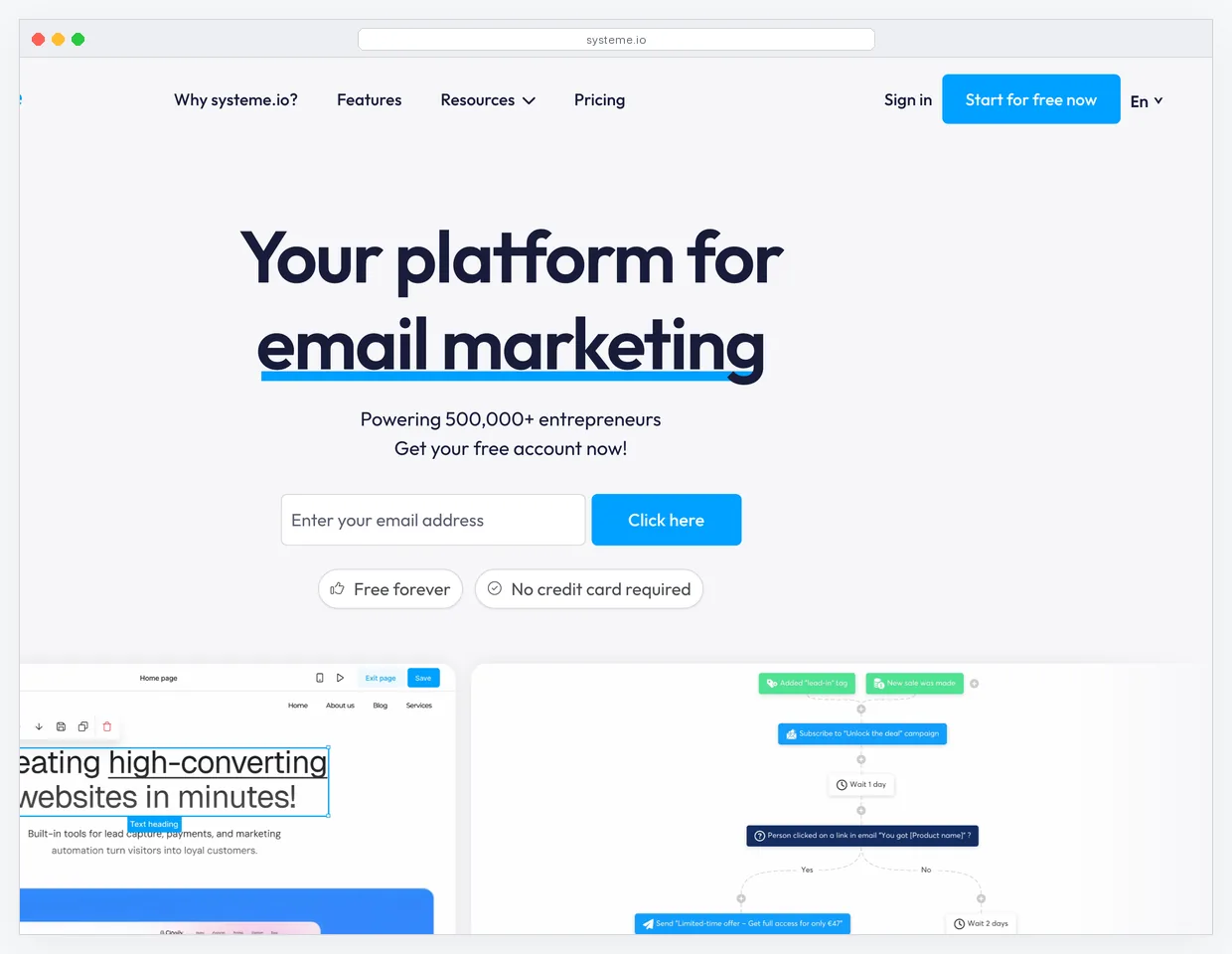
Systeme.io is the platform I recommend first to anyone building a digital product funnel for the first time. The free plan covers 2,000 contacts, three sales funnels, one custom domain, and unlimited emails. That is enough to launch and validate a $97 to $497 product with no monthly cost until you cross 2,000 contacts. The paid tiers cap at $97/mo for unlimited contacts, which is the same price point ClickFunnels charges for its starter plan.
The funnel editor follows a step-based pattern. You pick the funnel goal (sell a product, capture leads, run a webinar), the platform builds the page sequence, and you customize each page in a drag-drop editor. Email automations attach to funnel events: opted in, purchased, abandoned cart, watched the video. The order-bump and one-click upsell flows are included on every paid plan, which matters because that is where the AOV lift lives.
Where it gets thin: the page editor is fast for funnel layouts and limited for content pages with sidebars or complex grids. The community is smaller than ClickFunnels'. The advanced segmentation has caught up to ConvertKit but is not at GetResponse depth. None of these are launch blockers for a sub-$50K product business.
Pricing: Free for 2,000 contacts and 3 funnels. Startup at $27/mo for 5,000 contacts and 10 funnels. Webinar at $47/mo for 10,000 contacts and 50 funnels. Unlimited at $97/mo. Limitation: the page editor optimizes for funnel anatomy, not content sites. Run your blog elsewhere.
2. Kartra: best no-code funnel builder for coaches and course creators
Best for: coaches, consultants, and course creators selling at $297 to $2,000 AOV with multi-step launch sequences.
Kartra is the platform that consistently appears in the stacks of coaches running $30K to $200K per launch. The funnel editor models the platform around campaigns, not pages. A campaign is a complete sequence of pages, emails, tags, and behaviors. You design the customer's path through the launch and the platform fills in the page templates that match. The membership site module is built into the platform, which removes the second tool that course creators on ClickFunnels need.
The behavior-based automation builder is what separates Kartra from Systeme.io for this use case. You can branch a sequence on whether someone clicked a specific link in email three, watched 60% of the launch video, or visited the sales page twice without buying. That kind of branching is the difference between a generic launch and a launch that hits 8 to 12% conversion on a warm list.
Where it gets thin: the analytics surface is workable but you will pair Kartra with a separate analytics tool for funnel reporting at scale. Email deliverability requires a dedicated domain to hit Klaviyo numbers. The page editor is fast for marketers and slow for designers used to Webflow.
Pricing: Starter at $119/mo for 2,500 contacts and one custom domain. Growth at $229/mo for 12,500 contacts. Pro at $549/mo for unlimited team seats. 14-day free trial. Limitation: the page editor will frustrate Webflow-trained designers in the first hour.
3. ClickFunnels 2.0: best no-code page editor in the funnel category
Best for: operators who have launched 10+ funnels and want the most polished editor and template library.

ClickFunnels 2.0 is the version of the platform that finally caught up. The original ClickFunnels Classic was the dominant player for years but lagged on speed and editor quality. 2.0 ships a faster page renderer, a real CRM module, and a customer center for membership and digital products. It is the platform with the largest user community and the deepest template library, which means whatever niche you are launching in, someone has shipped a similar funnel and you can learn from it.
The platform's tax is the price. Basic at $97/mo is competitive with Kartra and Systeme.io's higher tiers, but the contact limit on Basic (10,000) is generous compared to Kartra's 2,500 at $119. The Pro plan at $297/mo unlocks a real CRM, three users, and 25,000 contacts. For an operator running multiple funnels at $30K+ MRR, Pro pays for itself by removing a separate CRM subscription.
Where it gets thin: the platform is opinionated. Every page wants to be a funnel page. If your business model includes a content blog, an event calendar, or a community forum, ClickFunnels will fight you. Email deliverability is workable but not at GetResponse or Klaviyo levels.
Pricing: Basic at $97/mo for 10,000 contacts and one user. Pro at $297/mo for 25,000 contacts, three users, and CRM. Funnel Hacker at $497/mo for 100,000 contacts and unlimited users. 14-day free trial. Limitation: ClickFunnels is funnel-shaped. The blog and community features were added later and feel like it.
4. GoHighLevel: best no-code funnel builder for agencies
Best for: agencies running funnels for 5+ clients with white-label dashboards and per-client customization.
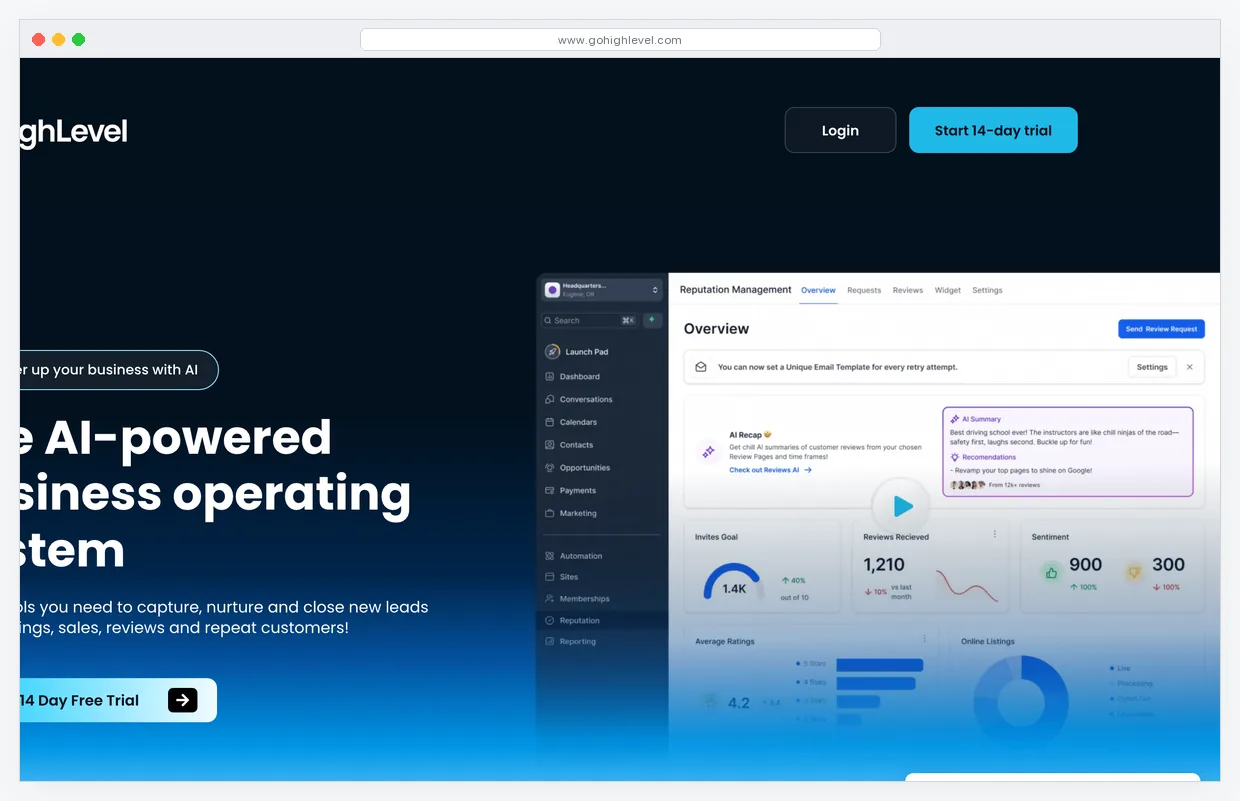
GoHighLevel is the platform agencies pick when the math says one tool replaces five. The funnel builder ships pages, email, SMS, calendar booking, pipeline tracking, and white-label client dashboards in a single subscription. For a typical agency client at $400/mo of separate tools (ConvertKit + Calendly + Pipedrive + Twilio + landing page tool), GoHighLevel Unlimited at $297/mo per agency replaces all of it across unlimited clients.
The snapshot system is the lever. You build a funnel template once, save it as a snapshot, and clone it across every new client account in roughly 90 seconds. The agency can scale from 5 to 50 clients without rebuilding from scratch. The white-label app at the SaaS Pro tier ($497/mo) lets the agency resell sub-accounts with their own branding, which is where the resale margin sits.
Where it gets thin: the page editor is competent but not at ClickFunnels 2.0 polish. The learning curve is roughly 30 hours, which is real cost. The platform is overpowered for a single-business operator. Solopreneurs should start on Systeme.io or Kartra, not GoHighLevel.
Pricing: Starter at $97/mo for solo use, no white-label. Unlimited at $297/mo for unlimited sub-accounts and white-label. SaaS Pro at $497/mo for the reseller mode. 14-day free trial. Limitation: the platform's depth is its tax. Plan two weeks for the team to be productive.
5. GetResponse: best email-led no-code funnel builder
Best for: teams running list-based funnels where the email sequence is the primary revenue driver.
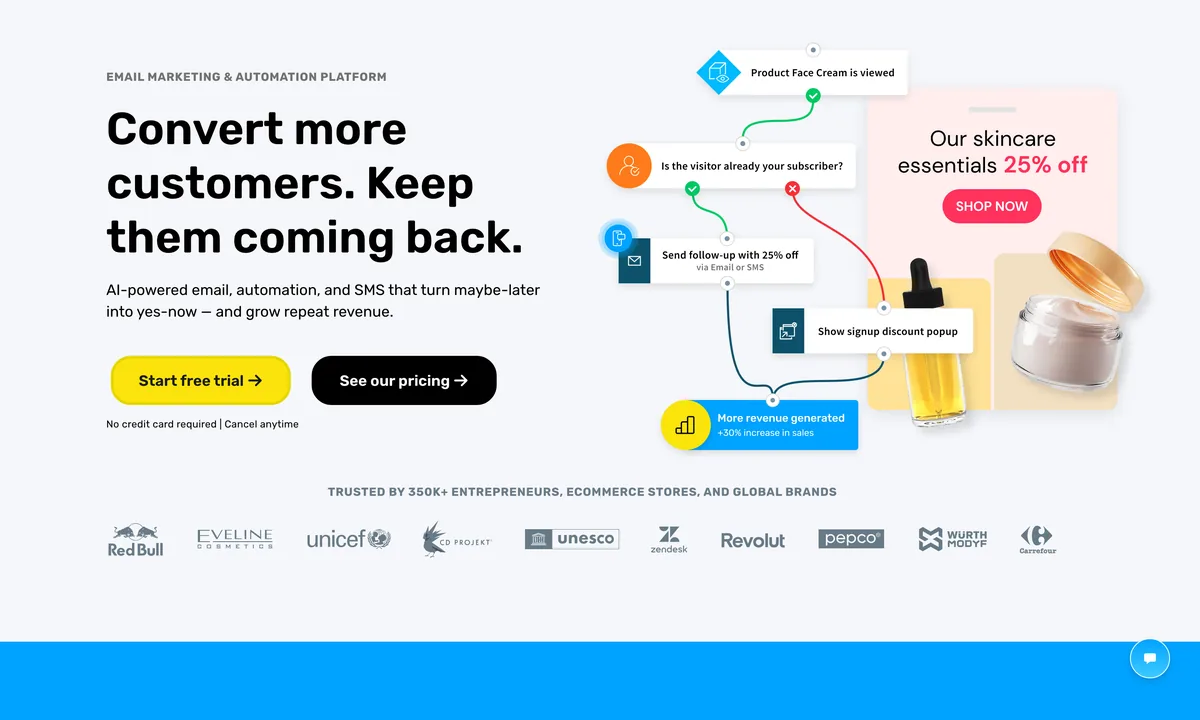
GetResponse is the funnel builder you pick when the email sequence is the heart of the business. The conversion funnels feature ships templates for lead magnet, sales, and webinar funnels, and the email automation builder is more capable than what you find inside Kartra or ClickFunnels. The webinar tool is built into the platform, which removes the typical second-tool subscription for course creators.
The contact-based pricing model is friendly to growth. The Starter Email plan at $15.58/mo for 1,000 contacts undercuts most competitors, and the Marketing Automation tier at $48.38/mo unlocks the full automation depth. The MAX tier (custom pricing) is for teams running more than 100,000 contacts with dedicated IPs.
Where it gets thin: the page editor is competent but not best-in-class. Checkout has improved in 2025-2026 but is still not at Kartra or ClickFunnels depth for membership products. The platform's strength is email and automation, not the page layer.
Pricing: Free for up to 500 contacts. Starter Email at $15.58/mo for 1,000 contacts. Marketing Automation at $48.38/mo. Ecommerce Marketing at $97.58/mo. 30-day free trial. Limitation: if your funnel revenue depends on a polished sales page, run the page on Kartra or ClickFunnels and run email on GetResponse.
6. 10Web: best no-code funnel builder on WordPress
Best for: teams that want WordPress flexibility on the funnel and the AI-generated starting point.
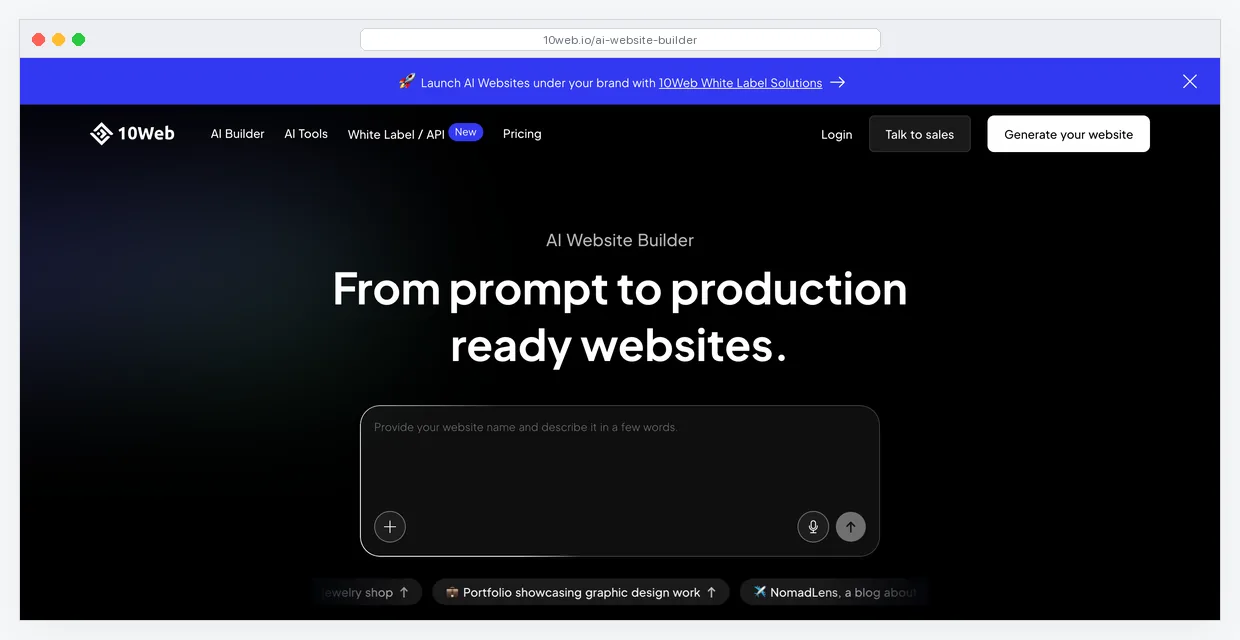
10Web is the funnel builder for teams that did not want to leave WordPress. The platform ships managed WordPress hosting on Google Cloud, the AI builder generates a starting site from a prompt, and you build the funnel using whatever WordPress page builder you prefer (Elementor, Beaver Builder, Bricks). Checkout runs on WooCommerce or a SaaS like ThriveCart. Email pairs with whatever ESP your stack already uses.
The trade-off is real. You give up the integrated funnel-plus-email-plus-checkout flow that Kartra and ClickFunnels deliver in one platform. You gain WordPress flexibility, lower hosting cost, and the option to integrate with the WordPress plugin ecosystem (membership plugins, LMS plugins, affiliate plugins) that Kartra and ClickFunnels do not match.
Where it gets thin: this stack is for teams that already prefer WordPress. If you do not, Kartra is a faster path. The AI builder produces a starter, not a finished design. Plan for two to four hours of polish work after the AI pass.
Pricing: Personal at $10/mo for one website with AI builder. Premium at $24/mo for 3 websites and ecommerce. Agency at $60/mo for 10 websites and white-label. 14-day free trial. Limitation: 10Web is a hosting and builder layer. The funnel logic comes from the WordPress plugins you add on top.
7. DashClicks: white-label agency funnels with fulfillment
Best for: agencies that want a funnel builder plus white-label fulfillment for SEO, paid ads, and content services.

DashClicks is the agency-focused platform that ships a funnel builder alongside white-label fulfillment services. Where GoHighLevel sells the agency platform and lets the agency build its own service stack, DashClicks sells the platform and the service stack together. SEO, paid ads, content, and reputation management are available as fulfillment SKUs the agency resells under its own brand.
The funnel builder is competent for agency use cases (lead capture, appointment booking, client onboarding) but less feature-rich than ClickFunnels for direct-to-consumer launches. The reporting dashboard is the strongest part of the product. Clients see a single white-label dashboard with traffic, leads, and campaign performance, which is the deliverable agencies typically build manually in Looker Studio.
Where it gets thin: the fulfillment marketplace is the lock-in. If you want best-in-class SEO, you are not buying it from DashClicks fulfillment, you are pairing the platform with a specialist agency or in-house team. The platform's strength is the bundled service catalog for agencies that want to skip the fulfillment build-out.
Pricing: Pro at $97/mo for funnel builder, dashboard, and CRM. Premium at $297/mo for white-label and fulfillment marketplace access. Limitation: the platform makes most sense for agencies actively reselling fulfillment, not for direct-to-consumer funnels.
How to pick a no-code funnel builder for your stage
The platform you pick is a function of revenue stage and team shape. Below is the rule of thumb I apply.
The trap to avoid: starting on the platform you will need at $1M ARR before you have launched anything. The fanciest tool is not the right tool. The right tool is the one you ship a funnel on this week.
When to leave a no-code funnel builder for custom code
You leave when one of three things is true. First, the page editor cannot ship the layout your designer hands you, and the platform refuses to accept custom HTML. That is a hard ceiling for a brand that competes on visual polish. Second, your conversion data shows that the page-load speed of the platform is costing you measurable revenue. The Largest Contentful Paint floor on most no-code platforms is around 2.5 seconds. A custom-built page on a managed CDN can hit 1.0 second. The difference at scale is real.
Third, the platform's API or webhook system cannot model the data flow your business requires. This is most common in subscription products, complex membership tiers, or regulated industries with consent and audit requirements. Shopify and custom Stripe integrations dominate at this end of the market.
For most operators, those thresholds are above $1M ARR. Below that line, no-code funnel builders are the right answer.
Frequently asked questions about no-code funnel builders
What is the difference between a no-code funnel builder and a landing page builder? A no-code funnel builder ships a multi-page sequence with checkout, email follow-up, and post-purchase logic. A landing page builder ships a single page. The funnel builder handles the entire customer path from opt-in to upsell. The landing page tool handles only the first page.
How fast can I launch a paid funnel on a no-code builder? A focused operator can launch a working funnel on Systeme.io in roughly 4 to 6 hours: page design, sales copy, checkout setup, email sequence, and a test purchase. Kartra and ClickFunnels are similar. Agencies typically allow 2 to 5 days for a polished client launch.
Do no-code funnel builders work for ecommerce? They work for low-SKU digital and physical products. For ecommerce above 50 SKUs with inventory tracking and variant management, you are better served by Shopify plus a checkout app like CartHook than by Kartra or ClickFunnels. Funnel builders are tuned for the launch and webinar use case, not the catalog use case.
How much should I budget per month for a funnel builder? $0 to $97/mo for solopreneurs (Systeme.io paid plan covers most cases). $97 to $297/mo for established operators. $297 to $497/mo for agencies. Email and SMS volume costs are typically separate from the platform fee.
Can I use Stripe with a no-code funnel builder? Yes. Every platform on this list integrates with Stripe (and PayPal) natively. Kartra and ClickFunnels also support order bumps and one-click upsells through their Stripe integration, which is the part that turns a funnel into a real revenue lever.
What to do next
If you have not launched a funnel before, start on Systeme.io's free plan this week. The cost of being wrong about the platform at $0/mo is zero. Once a launch validates, the migration to a paid plan or to Kartra is a one-time job.
If you are an established operator, the question is whether ClickFunnels 2.0 or Kartra fits your business model better. Both deliver multi-step funnels with email and checkout. Kartra's edge is course-and-coaching. ClickFunnels' edge is the editor polish and the template library.
For more on funnel-related tooling, see the landing page and checkout tools 2026 guide and the recent ClickFunnels vs Kartra comparison.