
Marketing Automation Software in 2026: The Agentic Shift and What to Buy Now
Canva bought an automation platform. Gartner says 40% of apps will embed AI agents by year-end. The marketing automation category as you knew it is over. Here is what replaced it and what to buy.

By Sara Mitchell, Marketing Analyst
Published April 2026 · · ● reading now

Disclosure: Some links in this article are affiliate links. We may earn a commission at no extra cost to you.
On April 8, 2026, Canva acquired Ortto (a marketing automation platform) and Simtheory (an AI agent management company) in a single day. A design tool bought a marketing automation stack. That is not a random product expansion. It is the clearest signal yet that the marketing automation category as it existed from 2015 to 2024 is done. The new category is not "automation." It is autonomous execution.
Gartner forecasts that 40% of enterprise applications will embed AI agents by the end of 2026, up from less than 5% in 2025. The marketing automation software market is worth $8.2 billion in 2026, growing at 12.9% annually. But the money is moving toward a fundamentally different product shape: tools that decide what to do, not just execute what you tell them.
If you are a solopreneur or small business owner watching this from the outside, the question is simple: does this matter for your stack right now, or is it enterprise theater that takes 5 years to reach your price bracket? This piece breaks down the answer.
The 2026 automation market has split into three tiers. Most small businesses need the middle one. Buying the wrong tier is the most expensive mistake you can make this year.
The three tiers of marketing automation in 2026
Every marketing automation tool on the market now falls into one of three categories. The category matters more than the feature list, because it determines what the tool can do without you.
The three tiers
Tier 1: Rule-based. You build every if-then rule manually. The tool executes exactly what you define. (Mailchimp, Brevo free tier, early Systeme.io)
Tier 2: AI-assisted. You set the goal. The tool suggests or optimizes timing, subject lines, send frequency, and segments. You approve or override. (GetResponse, ActiveCampaign, Klaviyo, Omnisend)
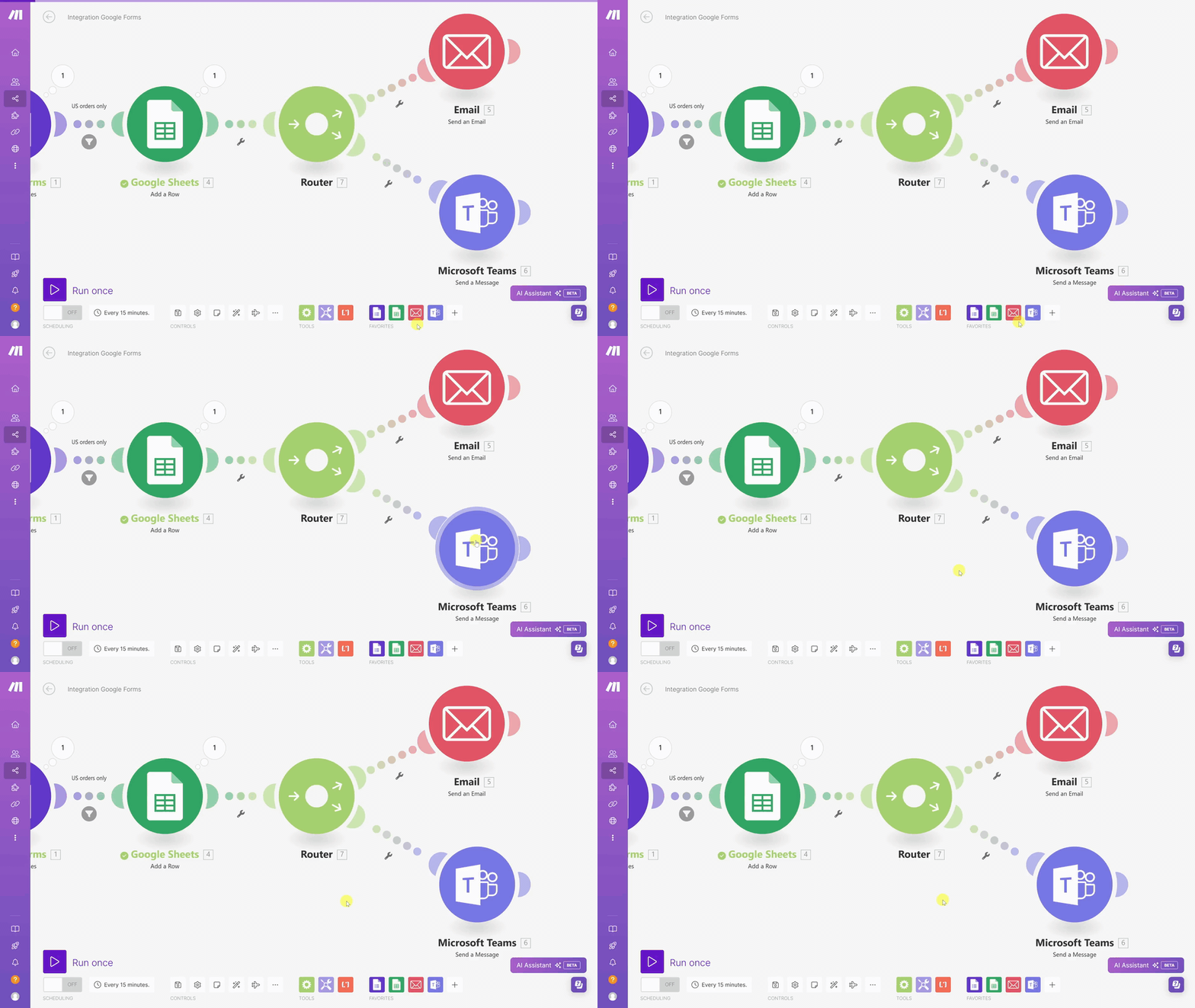
Tier 3: Agentic. The tool monitors performance, identifies problems, and takes action autonomously within guardrails you set. (GoHighLevel AI, Okara AI CMO, HubSpot Breeze, Salesforce Agentforce)
Tier 1 is where most solopreneurs started. You build a welcome email sequence, an abandoned cart flow, a re-engagement campaign, all manually. The tool does not adapt. If open rates drop from 40% to 22% over three months, a Tier 1 tool keeps sending the same emails on the same schedule until you notice and fix it yourself.
Tier 2 adds intelligence on top of execution. The tool analyzes your data and suggests changes: "Send this email at 9:14 AM instead of 8:00 AM because your audience opens 23% more often in the 9 AM window." Or: "This subject line variant generated 31% higher open rates in the A/B test, applying it to the remaining 80% of the send." You still make the final call, but the tool does the analysis work that used to require a $2,000/month consultant.
Tier 3 is what the Canva/Ortto acquisition is about. An agentic tool does not suggest. It acts. It notices your abandoned cart recovery rate dropped 4 percentage points this week, identifies that the problem is send timing (not subject line), adjusts the trigger delay from 60 minutes to 45 minutes, and reports what it did in a dashboard log. You set the guardrails. The agent operates within them.
What actually changed in 2026
Three events in the first four months of 2026 made the tier split visible to everyone.
1. Canva bought Ortto and Simtheory (April 8, 2026). A design platform with 200 million users acquired a marketing automation company serving 11,000 customers and an AI agent management platform in the same transaction. The signal: marketing automation is becoming an embedded feature inside broader platforms, not a standalone category. Within 18 months, Canva users will be able to design an email, build the automation flow, and deploy an AI agent to optimize send timing, all without leaving Canva. That collapses the boundary between "creative tool" and "automation tool" permanently.
2. Agentic AI spending hit $201.9 billion globally. That is not a projection. That is the 2026 market reality per industry analyst estimates. The practical impact for small business: every SaaS vendor from GoHighLevel to Klaviyo is shipping agent-like features this year, not next year. The timeline for these capabilities to reach the $20 to $100/month price tier compressed from "3 to 5 years" to "already happening."
3. The "too many tools" problem hit a wall. The HubSpot State of Marketing report identifies "too many disconnected tools" as the top marketing operations complaint among SMBs. The average small business runs 5 to 8 marketing tools. Each tool has its own contact list, its own analytics dashboard, its own billing cycle. AI agents are the first technology that can actually sit across those tools and coordinate them, which is why the connector category (Make, Zapier) is now shipping AI-powered scenario builders that write automations from natural language descriptions.
The vendor hype filter
Every automation tool now claims "AI-powered." Test it with one question: does the tool take action on its own, or does it just show you a suggestion you still have to click? If it is suggestions-only, it is Tier 2 (AI-assisted), not Tier 3 (agentic). Both are valuable. But do not pay Tier 3 prices for Tier 2 features.
Where each tool sits in the tier map
Here is how the major platforms map to the three tiers as of April 2026. Some tools straddle two tiers because they ship Tier 2 features on lower plans and Tier 3 features on higher plans.
| Tool | Tier | AI Features (2026) | Starting Price | Best For |
|---|---|---|---|---|
| GetResponse | Tier 2 | AI subject lines, send-time optimization, AI landing page builder | $19/mo | SMBs wanting all-in-one email + automation |
| ActiveCampaign | Tier 2 | Predictive sending, win probability scoring, AI content generation | $15/mo | Businesses needing deep CRM + automation |
| Omnisend | Tier 2 | AI campaign assistant, product recommendations, send-time optimization | $16/mo | Ecommerce stores on Shopify |
| Klaviyo | Tier 2–3 | Predictive CLV, churn risk, AI segments, Klaviyo AI (generative) | $45/mo | Scaled ecommerce ($30K+/mo) |
| GoHighLevel | Tier 2–3 | AI conversation bot, workflow AI assistant, predictive lead scoring | $97/mo | Agencies and multi-location businesses |
| Systeme.io | Tier 1 | None (rule-based automation only) | Free | Budget-constrained solopreneurs |
| Brevo | Tier 1–2 | AI subject line generator, basic send-time optimization | $9/mo | Transactional + marketing email combo |
| Make | Tier 2 | AI scenario builder (natural language to workflow), AI data mapper | $9/mo | Connecting existing tools with visual logic |
| Okara AI | Tier 3 | AI CMO with 6 autonomous agents (SEO, copy, social, GEO) | $99/mo | Startups wanting autonomous marketing |
What this means for your stack right now
The practical implications depend on where your business sits today. Here are the three most common positions and the correct move for each.
Position 1: You are on a Tier 1 tool (Systeme.io free, Mailchimp free, basic Brevo). You are leaving money on the table. Automated emails generate 37% of all email-driven revenue from just 2% of sends, per Omnisend's 2025 data. A Tier 1 tool runs those automations, but it does not optimize them. The difference between a Tier 1 abandoned cart flow and a Tier 2 flow with send-time optimization and AI subject lines is typically 15 to 30% more recovered revenue from the same list. At $16/mo for Omnisend or $19/mo for GetResponse, the upgrade pays for itself on the first recovered cart of the month.
Position 2: You are on a Tier 2 tool (GetResponse, ActiveCampaign, Omnisend) and it is working. Stay. You are in the right tier for 2026. The AI features in Tier 2 tools are genuinely useful and they are improving every quarter. Do not chase Tier 3 agentic tools yet unless you have a specific, measurable problem that Tier 2 cannot solve. The most common one: you run 10-plus automation sequences and do not have time to review performance data on all of them weekly. That is the pain point where agentic monitoring becomes worth the price jump.
Position 3: You are evaluating a Tier 3 tool (GoHighLevel AI, Okara AI CMO, HubSpot Breeze). Ask two questions before you buy. First: does your business generate enough data for an AI agent to learn from? If you send fewer than 5,000 emails a month or run fewer than 100 orders a month, there is not enough signal for a Tier 3 agent to outperform your own judgment. Second: are you comfortable with the tool taking action without your approval? Tier 3 tools will adjust send times, rewrite subject lines, and reallocate campaign budgets autonomously. If you need to review every change, you are paying for Tier 3 and using it as Tier 2.
The buy, hold, or switch decision for 2026
Based on the tier map and the 2026 market shifts, here is the specific guidance for each tool.
GetResponse ($19/mo). BUY if you need an all-in-one. The AI features (send-time optimization, AI subject lines, AI landing page builder) make this the strongest Tier 2 value for solopreneurs who want email, automation, landing pages, and webinars in one subscription. If your current stack is Mailchimp free or Brevo free, GetResponse is the upgrade that adds AI optimization without tripling your monthly cost.
ActiveCampaign ($15/mo). HOLD if you are already on it. The automation builder is still the deepest in the Tier 2 category: conditional splits, wait-until logic, goal tracking, CRM deal stage triggers. The AI features (predictive sending, win probability) are solid but not unique. Do not switch from ActiveCampaign to something else just for AI features. Do switch if you are paying over $150/mo and using less than 50% of the platform.
Omnisend ($16/mo). BUY if you run a Shopify store. The ecommerce-specific pre-built flows (abandoned cart, browse abandonment, post-purchase) with AI optimization are the fastest path from "no automation" to "automation that generates revenue." The free tier is enough to prove the value. Upgrade to paid when you need SMS.
Klaviyo ($45/mo). HOLD or BUY if you are past 5K contacts. Klaviyo is straddling Tier 2 and Tier 3 in 2026. The predictive analytics (churn risk, next order date, predicted CLV) are approaching agentic territory. At scale, the data advantage compounds. Below 5,000 contacts, the price premium over Omnisend is not justified by the AI features.
GoHighLevel ($97/mo). BUY if you run an agency or multiple brands. The AI conversation bot and workflow assistant push GoHighLevel into Tier 2-3 territory for agencies that need CRM, email, SMS, funnels, and AI in one platform. Overkill for a solo operator with one product line. Worth every dollar for someone managing 5-plus client accounts.
Systeme.io (Free). HOLD as a starter, plan to graduate. The best free automation tool on the market. But it is firmly Tier 1 with no AI features, which means you will outgrow it the moment you need send-time optimization or predictive segmentation. Use it to validate your first funnel, then move to GetResponse or ActiveCampaign when revenue justifies $15 to $19/mo.
Make ($9/mo). BUY as a connector alongside any platform. The 2026 AI scenario builder lets you describe an automation in plain English and Make builds the workflow. That feature alone saves 2 to 3 hours per complex scenario. If you use more than 2 marketing tools that need to talk to each other, Make is a Tier 2 connector that pays for itself in the first week.
Okara AI ($99/mo for AI CMO). WAIT unless you are a funded startup. The AI CMO with 6 autonomous marketing agents (SEO, content, Reddit, Hacker News, X, GEO) is the most ambitious Tier 3 product at this price point. But at $99/mo, it needs to replace at least $300/mo in contractor work to justify the cost. If you are spending $0 on marketing labor today, you do not have enough existing workflow for autonomous agents to improve. If you are spending $500-plus on freelancers, this is worth testing.
The counter-argument: why staying on Tier 1 is still rational
There is a legitimate case for staying on a Tier 1 tool in 2026, and it comes down to one variable: how much time you spend on marketing per week.
If you spend fewer than 3 hours a week on marketing, you are not generating enough automation data for AI to improve anything. A Tier 1 tool running a basic welcome sequence and an abandoned cart flow on autopilot will capture 80% of the automation value for $0 to $27 a month. The incremental revenue from AI-optimized send times on a 500-person list is maybe $20 to $50 a month. That does not justify a $19/mo platform upgrade if your time is the real constraint.
The break-even point where Tier 2 becomes worth the price is roughly: 2,000 contacts, 10-plus emails per month, and at least $5K in monthly revenue flowing through email-influenced channels. Below that threshold, the math favors simplicity. Above it, the math favors intelligence.
The one number that matters
Calculate your email revenue per subscriber per month. If it is above $0.50, Tier 2 AI features will measurably increase it. If it is below $0.50, focus on list growth and offer quality before paying for optimization. AI cannot optimize what does not exist yet.
What happens next: the 12-month forecast
Three trends that will reshape tool selection by early 2027.
Canva ships an integrated automation product. The Ortto acquisition closes and integrates. Within 12 months, Canva will offer email automation, customer data management, and AI agent optimization inside the same tool you use for social media graphics. If the pricing follows Canva's pattern, it will undercut standalone automation tools by 30 to 50%. Every Tier 1 and low-end Tier 2 vendor is on notice.
Tier 2 becomes the floor. AI-assisted features (send-time optimization, AI subject lines, predictive segments) are already standard in the $15 to $20/mo tier. By 2027, even free tiers will include basic AI assistance. Tier 1 "dumb" automation will stop being a viable category entirely. If you are still on a Tier 1 tool when that happens, you will be forced to migrate under time pressure instead of choosing when it is convenient.
Agent interoperability becomes the differentiator. The tools that win in 2027 will not be the ones with the best AI agent inside their own platform. They will be the ones whose agents can coordinate with agents from other tools. A Make AI agent that triggers a Klaviyo AI agent that adjusts an Omnisend campaign based on data from a GoHighLevel CRM, all without human intervention. That is the endgame. We are not there yet, but the vendors racing toward it (Make, Zapier, n8n) are the connectors, not the platforms.
Frequently asked questions
What is the best marketing automation software for a small business in 2026?
GetResponse at $19/mo for most small businesses. It covers email, automation, landing pages, and webinars in one platform with Tier 2 AI features (send-time optimization, AI subject lines). For ecommerce specifically, Omnisend at $16/mo is the better pick because of its native Shopify integration and pre-built ecommerce flows. For a detailed comparison of 12 tools, see our buying guide.
Is AI marketing automation worth it for solopreneurs?
Yes, once you cross roughly 2,000 contacts and $5K in monthly email-influenced revenue. Below that threshold, a free Tier 1 tool like Systeme.io captures most of the value. Above it, Tier 2 AI features (send-time optimization, predictive segments) typically increase email revenue 15 to 30% from the same list, which more than covers the $15 to $19/mo subscription cost.
What is the difference between AI-assisted and agentic marketing automation?
AI-assisted (Tier 2) tools analyze your data and suggest optimizations that you approve. Agentic (Tier 3) tools take action autonomously within guardrails you set. Example: a Tier 2 tool suggests changing your send time from 8 AM to 9 AM. A Tier 3 tool changes it automatically, monitors the result, and adjusts again next week without asking. The price difference is typically 3 to 5x ($15-$45/mo vs. $97-$300/mo).
Should I switch from Mailchimp to something else in 2026?
If you are on Mailchimp's free plan, yes. Mailchimp's free tier has been cut repeatedly and now limits you to 500 contacts. GetResponse at $19/mo or Omnisend at $16/mo both offer stronger AI features, higher contact limits, and better automation depth. If you are on a paid Mailchimp plan and happy with it, the switching cost (migrating lists, rebuilding automations) is only worth it if you need features Mailchimp does not offer, like predictive analytics or native SMS.
Will Canva replace standalone marketing automation tools?
Not in 2026, but possibly by 2027-2028. The Ortto acquisition gives Canva a real automation engine, and Simtheory adds AI agent capabilities. But integration takes time. For the next 12 months, standalone tools like GetResponse, ActiveCampaign, and Omnisend remain the safer choice. Watch Canva's product announcements closely starting in late 2026, and plan a potential migration window for early 2028 if the pricing is competitive.
Where to go from here
If you know which tier you need and want specific tool comparisons with pricing breakdowns, read the full marketing automation buying guide. If you want a matched tool recommendation based on your business type and budget, use the AI stack advisor.
The 2026 automation market is moving fast. The right move is not to chase the newest tier. It is to be on the right tier for your current revenue and data volume, with a clear plan for when to upgrade.