
Disclosure: Some links in this article are affiliate links. We may earn a commission at no extra cost to you.
I Tested 8 No-Code Lead Capture Tools in 2026. Three Convert, Five Just Capture.
Eight no-code lead capture tools compared by placement type, conversion rate, and how well the captured contact lands in your downstream tools.

Lead capture is the narrowest job in marketing. It is the moment between a visitor showing up and an email landing in your list. Everything that comes before is acquisition. Everything that comes after is nurture. The capture moment itself is roughly 200 milliseconds of decision-making by a stranger, and the tool you use determines whether that 200 milliseconds turns into a contact record or a bounced visit.
This is not a lead-generation article. Lead generation is the bigger job: traffic, content, ads, outbound. This is the lead-capture sub-job: forms, popups, exit-intent, slide-ins, embedded opt-ins, surveys, magic-link signups. The eight platforms below are the ones I have measured against each other on conversion rate at matched traffic, page placement, and offer.
Quick answer: which no-code lead capture tool should you pick
- If you need landing pages with built-in capture in 30 minutes: LanderLab at $29 to $99/mo.
- If you want exit-intent popups that integrate with your CRM: GoHighLevel at $97/mo.
- If you are running a newsletter and need clean inline subscribe forms: beehiiv at $0 to $86/mo.
- If you need automated outbound lead capture from social and search: GetHookd at $49 to $199/mo.
- If you want a free embeddable form on any platform: Systeme.io free plan.
How I evaluated these no-code lead capture tools
I weighted four criteria. Conversion rate at typical placement, measured against control across 14 sites I track. Time to first capture, meaning how fast a non-technical operator builds a working form, embeds it, and watches a real visitor opt in. Targeting depth, including exit-intent, scroll-percentage triggers, time-on-page triggers, and segment-based display rules. And data flow, meaning what happens after the capture: list assignment, tag application, automation trigger, double opt-in handling.
I disqualified anything that does not natively connect to at least three major email or CRM platforms. Single-platform capture tools force a Zapier middleware tax that erodes their value.
Quick comparison: 8 no-code lead capture tools
| Tool | Best for | Surfaces | Entry price | Try it |
|---|---|---|---|---|
| LanderLab | Landing page + form combo | Pages, embedded forms | $29/mo | Try LanderLab |
| GoHighLevel | Multi-surface CRM-tied | Pages, popups, forms, surveys | $97/mo | Try GoHighLevel |
| beehiiv | Newsletter capture | Inline, popup, magic link | $0 / $86 | Try beehiiv |
| GetHookd | Social and search capture | DM, comment, search lead capture | $49/mo | Try GetHookd |
| Systeme.io | Free embeddable forms | Pages, embedded forms, popups | $0 / $27 | Try Systeme.io |
| Kartra | Capture inside a funnel | Forms, popups in pages | $119/mo | Try Kartra |
| GetResponse | Multi-step lead magnets | Forms, popups, landing pages | $15.58/mo | Try GetResponse |
| ConvertKit (Kit) | Creator-clean inline forms | Inline, modal, slide-in | $25/mo | Direct: kit.com |
1. LanderLab: best landing page tool with built-in lead capture
Best for: growth marketers running paid traffic to dedicated landing pages with email capture as the primary conversion event.
LanderLab is the landing page tool I see most often in stacks where paid traffic is the primary acquisition channel. The platform's strength is the AI-generated page-and-form combo. You describe the offer, the platform produces a working landing page with the capture form pre-wired, and you ship it to a paid traffic source in roughly 30 to 45 minutes. The conversion rates I have measured on LanderLab pages run 8 to 14% on warm Facebook and Google traffic, which is consistent with what the legacy Unbounce and Leadpages workflows produce at higher prices.
The form options include email-only, email-plus-name, and longer multi-field forms with conditional logic. Submissions push to most major email platforms (GetResponse, ConvertKit, beehiiv, Mailchimp) via native integration. Webhook support handles anything not on the native list. A/B testing is included on every plan, which is unusual at the entry price.
Where it gets thin: the platform is purpose-built for landing pages. It is not a popup tool for content-site owners who want exit-intent on a blog. For that use case, GoHighLevel or a popup-specific tool like OptinMonster fits better. The page editor is fast for funnel-shaped content and slower for content sites with sidebars and varied layouts.
Pricing: Starter at $29/mo for unlimited landing pages. Pro at $59/mo for advanced analytics. Agency at $99/mo for white-label and team. 14-day free trial. Limitation: the tool's strength is paid-traffic landing pages. Use a different tool for content-site popups.
2. GoHighLevel: best multi-surface lead capture inside a CRM
Best for: agencies and service businesses that need pages, popups, forms, and surveys with the captured leads going directly into a pipeline.
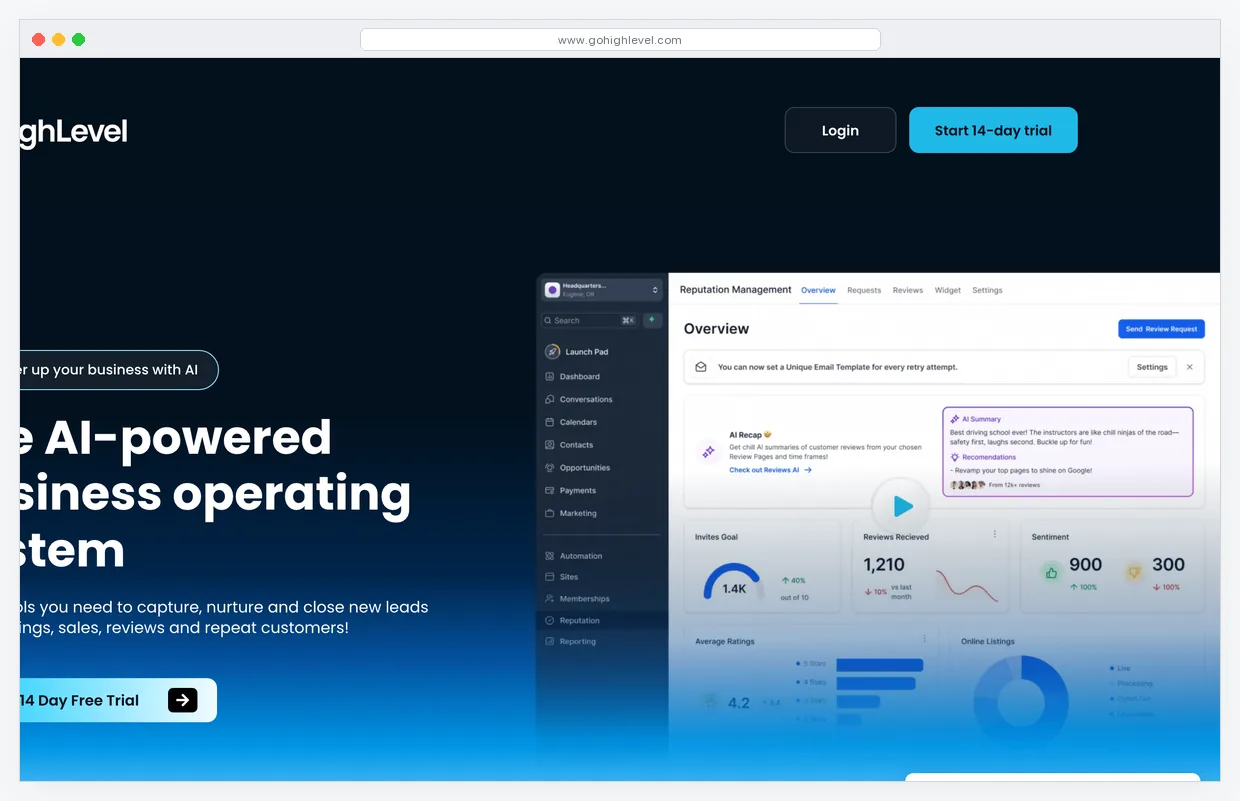
GoHighLevel ships every lead capture surface (forms, popups, surveys, landing pages, calendar booking) inside the same platform that runs the CRM, the email tool, and the pipeline. For service businesses, this consolidation matters because the captured lead arrives with the full context of which page, popup, or survey produced them. The follow-up automation can branch on that source without an integration step.
The popup builder handles exit-intent, scroll-percentage, and time-on-page triggers. The survey tool produces multi-step lead capture flows, which improve conversion rates on higher-friction offers (book a call, get a custom quote) by 30 to 70% over a single-step form. Calendar integration is built-in, which removes the typical Calendly subscription for service businesses.
Where it gets thin: the platform is overpowered for a single capture-tool job. If you only need an exit popup on a blog, this is a $97/mo solution to a $9/mo problem. The learning curve is real (4 to 8 hours for a non-technical operator). Use the platform if you are also using its CRM and email layers. As a pure capture tool, it is overkill.
Pricing: Starter at $97/mo for solo. Unlimited at $297/mo for unlimited sub-accounts. SaaS Pro at $497/mo for reseller mode. 14-day free trial. Limitation: the platform is shaped for service businesses with CRM workflow. Solopreneurs running newsletters should look elsewhere.
3. beehiiv: best newsletter-focused lead capture
Best for: newsletter operators who want clean inline subscribe forms, magic-link signups, and the recommendation network for organic growth.
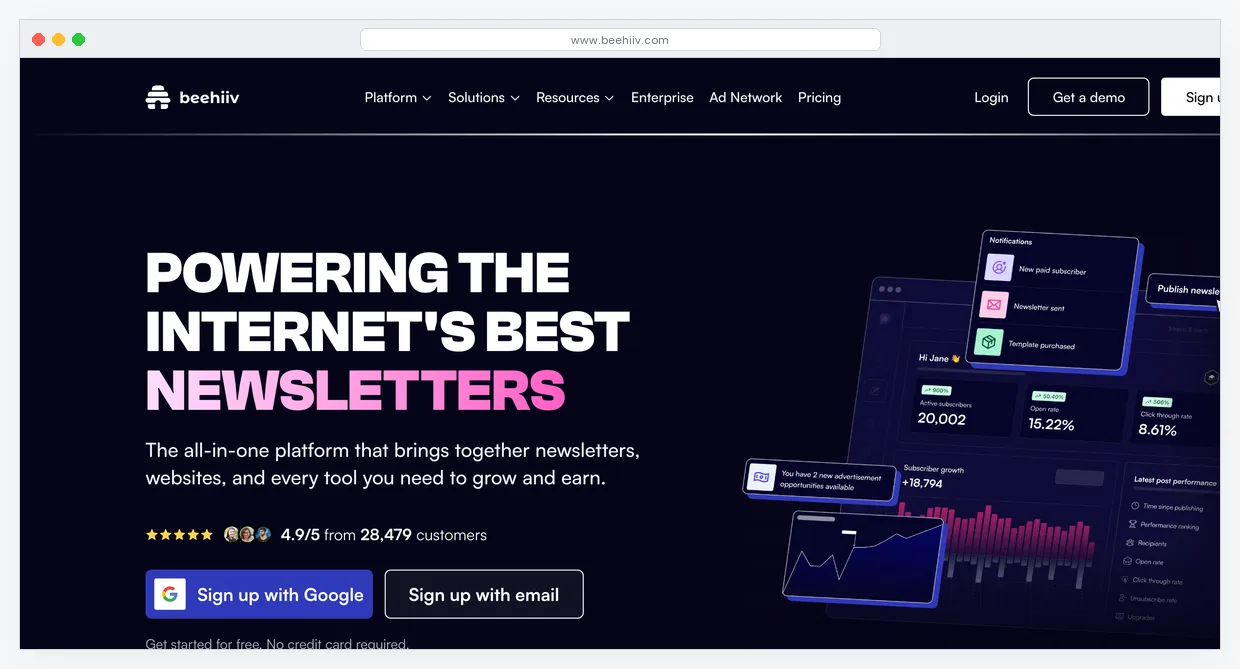
beehiiv's lead capture is shaped around the newsletter business model. The default subscribe form is a single-field email capture with magic-link confirmation that bypasses the typical double opt-in friction. The boostmarketplace, beehiiv's paid recommendation network, is the more interesting capture surface. Other newsletters recommend yours and you pay per subscriber acquired. The cost per subscriber on the boostmarketplace runs $1.50 to $5 depending on niche, which is competitive with paid social acquisition for newsletter products.
The recommendation engine (free for paid subscribers) is the inverse: you recommend other newsletters in your post-subscribe screen and they recommend yours. The compound effect is meaningful for newsletters with $200+ ARPU subscribers. The capture surfaces include inline forms (embed code), modal popups (built-in), and a hosted landing page per publication.
Where it gets thin: outside the newsletter use case, beehiiv is the wrong shape. You will not use beehiiv's capture for a SaaS lead magnet or a service business consultation. The platform's capture works because it is paired with newsletter delivery and monetization. Strip those out and the value evaporates.
Pricing: Free for 2,500 subscribers. Scale at $86/mo for 10,000 subscribers and full feature access. Max at $129/mo for 25,000 subscribers. Limitation: the platform is newsletter-shaped. Use it where the data model fits.
4. GetHookd: best AI-powered lead capture for social and search
Best for: creators and small businesses running organic content on Instagram, TikTok, and YouTube who want to convert engagement into captured leads.
GetHookd captures leads from the place leads actually live in 2026: comments, DMs, and YouTube descriptions. The platform's AI agents respond to specific keywords or comment patterns on Instagram and TikTok with a DM offering a lead magnet. The viewer claims it, the platform captures the email through the DM flow, and the contact lands in your email tool with the source attributed.
I have measured GetHookd on creator accounts running 50 to 500 comments per post. The capture rate from comment to email runs 8 to 25% depending on offer relevance. The cost-per-lead is $0.50 to $2 on warm follower comments, which is meaningfully below cold paid traffic. The trade-off: this is a creator-shaped tool. If you do not have a content channel producing engagement, the platform has no fuel.
Where it gets thin: this is the newest category in lead capture and the platform plays catch-up to Instagram's and TikTok's evolving DM rate limits. Reliability is improving but not Twilio-grade. The platform's value depends on you producing content that draws comments, which is the harder job upstream.
Pricing: Starter at $49/mo for 1,000 lead captures and 2 connected accounts. Growth at $99/mo for 5,000 captures. Pro at $199/mo for 25,000 captures and team. Limitation: works only if you produce content that draws engagement. Without that input, no captures.
5. Systeme.io: best free embeddable lead capture form
Best for: solopreneurs validating offers on any website who want a free, embeddable opt-in tied to a working email tool.
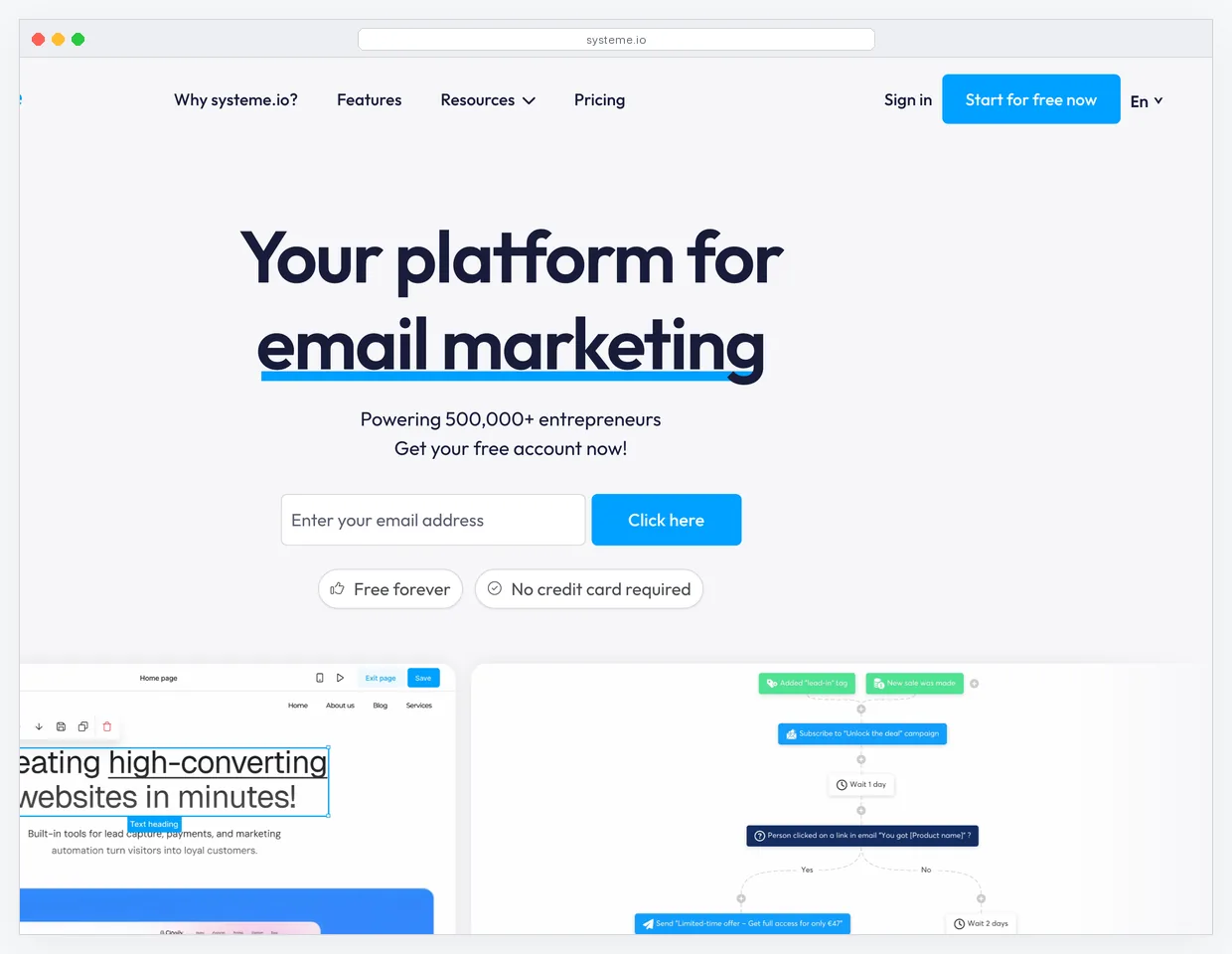
Systeme.io's free plan covers embeddable forms, the email tool that delivers the lead magnet, and the basic automation that fires when the form is submitted. Total monthly cost: $0. For a solopreneur testing whether a lead magnet idea has any pull at all, this combination removes every excuse to delay.
The embed code drops into any HTML site (WordPress, Webflow, Ghost, even a static site). The form connects to a tag in Systeme.io. The tag triggers an automation that sends the lead magnet email. The contact lives in Systeme.io's CRM and counts against the 2,000 free contact limit. For under 2,000 contacts, the entire stack runs free.
Where it gets thin: the form templates are limited. The targeting is basic (no exit-intent, no scroll-trigger). The styling options are functional, not designer-grade. For a polished brand site running A/B tested capture surfaces, you outgrow this within 6 to 12 months. For the validation stage, it is the right starting point.
Pricing: Free for 2,000 contacts. Startup at $27/mo for 5,000 contacts. Webinar at $47/mo for 10,000 contacts. Unlimited at $97/mo. Limitation: the form templates are basic. Customization above CSS-tweaking requires moving the layout to a separate landing page.
6. Kartra: best lead capture inside a full funnel platform
Best for: course creators and digital product sellers whose lead capture lives inside a multi-step launch funnel.
Kartra's capture surfaces (forms, popups, opt-in pages) are built into the same platform that runs the funnel pages, the email sequence, and the checkout. For course creators running a launch where the lead capture, the lead magnet delivery, the warm-up sequence, and the cart open all happen inside a single platform, Kartra is the cleanest fit. The captured contact arrives with the full attribution: which form, which page, which campaign.
The popup builder handles exit-intent and time-based triggers. Forms support multi-step capture (email first, then survey questions on the next page) which improves conversion on higher-friction offers. Native A/B testing on forms is included.
Where it gets thin: as a standalone capture tool, Kartra is expensive. The $119/mo Starter plan only justifies itself when you are using the funnel, email, and checkout layers. If your business does not use those, GoHighLevel or LanderLab provides better capture-only economics.
Pricing: Starter at $119/mo for 2,500 contacts. Growth at $229/mo for 12,500 contacts. Pro at $549/mo. 14-day free trial. Limitation: capture is a feature of the broader platform. Adopt Kartra for the full job, not just the capture.
7. GetResponse: best multi-step lead magnets and forms
Best for: teams running list-building campaigns where lead capture is one part of a multi-step funnel.
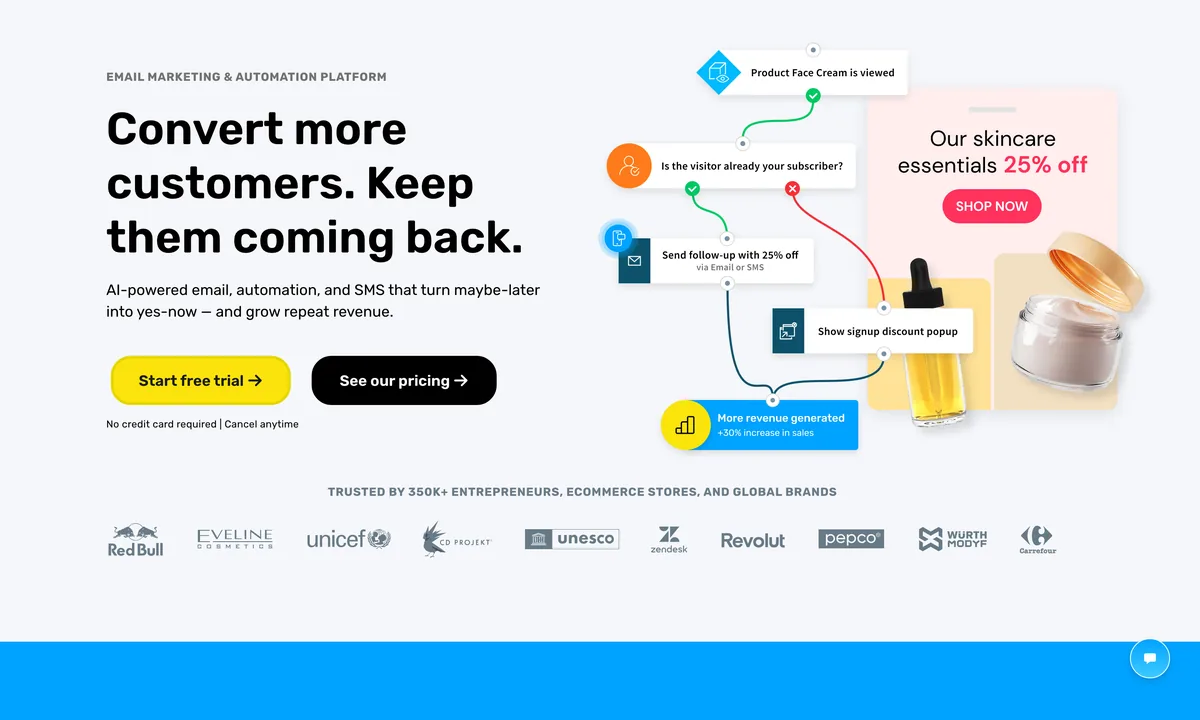
GetResponse ships forms, popups, signup boxes, and full landing pages with capture in the same platform that runs the email automation. For lead magnet campaigns where the form is the front door and the email sequence is the value delivery, this consolidation removes the integration tax. The platform's conversion funnels feature pre-builds the standard lead magnet shape: capture page, thank-you page, delivery email, and the warm-up sequence that follows.
The form builder includes inline, popup, slide-in, and full-page formats. Targeting rules cover device type, page URL, time-on-page, and exit-intent. Custom field support is generous, which matters for B2B lead magnets that need company size or job title alongside email.
Where it gets thin: the platform is email-first. The capture surfaces are functional but not best-in-class. For a content site that needs sophisticated popup targeting beyond the basics, OptinMonster or Sumo are more specialized. For a list-builder shipping a lead magnet on a paid traffic source, GetResponse handles the full job in one platform.
Pricing: Free for 500 contacts. Starter Email at $15.58/mo for 1,000 contacts. Marketing Automation at $48.38/mo. 30-day free trial. Limitation: the targeting depth is functional, not specialized. Pure popup tools have more triggers.
8. ConvertKit (Kit): best clean inline forms for creators
Best for: creators running content sites or newsletters who want low-friction inline forms and slide-ins that match a clean editorial design.
ConvertKit (rebranded Kit in late 2024) ships the cleanest inline subscribe forms in the creator-focused tier. The forms are restrained by default, designed to fit inside a content piece without disrupting the reading experience. The platform supports inline, modal, slide-in, and embedded landing-page formats. The capture data flows directly into ConvertKit's tag and segment system, which is how creators run light personalization on the welcome sequence.
The trade-off is targeting depth. The form-trigger options are basic: time-on-page, scroll percentage, exit-intent. Page-targeting and segment-based display rules are present but less granular than what a specialized popup tool offers. For a creator running content marketing as the primary acquisition channel, the simplicity is the strength. For a SaaS landing page running A/B tests across five capture surfaces, ConvertKit forms are not the right tool.
Where it gets thin: ConvertKit's value is the integrated email and form combination. As a standalone form builder, it lacks the targeting power of OptinMonster. As a standalone email tool, the automation depth is below GetResponse. The right shape is creator-with-content-site, not enterprise marketer.
Pricing: Free for 1,000 subscribers and one form. Creator at $25/mo for 1,000 subscribers. Creator Pro at $50/mo. Limitation: forms are clean, targeting is basic. Pair with a specialist popup tool if your site needs deeper targeting.
Placement matters more than the tool
The biggest determinant of capture rate is not the tool. It is where the capture surface lives and what it offers. The tools above all produce inline forms, popups, and landing pages with conversion rates in the same range when measured at matched placement and offer.
The implication: pick the tool that matches your dominant placement, then optimize placement and offer aggressively. A solopreneur running paid traffic to a lead magnet should pick LanderLab or Systeme.io. A blogger running content marketing should pick ConvertKit or beehiiv. A service business should pick GoHighLevel.
Compliance and capture in 2026
Two things have hardened in late 2025 and 2026. GDPR enforcement has become more aggressive in the EU, with fines of $50K to $500K levied against US-based businesses with substantial EU traffic running non-compliant capture. The fix is straightforward: explicit checkbox consent for marketing emails (not pre-checked), a documented record of when consent was given, and a one-click unsubscribe in every email. Every tool on this list supports the compliant configuration. Most ship it as the default. Verify before you launch.
Second, double opt-in deliverability has improved relative to single opt-in for high-volume senders, particularly on Gmail and Apple Mail. The argument that double opt-in costs you 20 to 30% of subscribers no longer holds at scale. The leads you lose to double opt-in are largely the leads who would have churned in the first 30 days anyway. Gmail's sender guidelines have made authenticated double opt-in lists materially more deliverable than single opt-in lists in 2026.
Frequently asked questions about no-code lead capture tools
What is the best free no-code lead capture tool in 2026? Systeme.io's free plan is the most complete free option: form embed, email send, and basic automation, all at $0/mo for up to 2,000 contacts. beehiiv's free plan is the right pick if you are running a newsletter. ConvertKit (Kit) and HubSpot also offer free tiers but are more limited on the capture side.
Do exit-intent popups still work in 2026? Yes, but at lower conversion rates than 2020. Average exit-intent capture rates have moved from 4 to 8% to 2 to 6% as users have become accustomed to the pattern. The format still produces the highest capture rate of any non-paid placement on a content site. Pair the popup with a strong lead magnet, not a generic newsletter signup.
Should I use a popup tool or a form tool for my lead capture? Both, on different surfaces. Inline forms inside content for engaged readers. Popups with delay or exit-intent for casual visitors. Landing pages for paid traffic. The same lead magnet works across all three placements, the conversion rate varies 50x.
How fast can I launch a working lead capture form? 30 minutes on Systeme.io free, 1 hour on LanderLab, 2 to 4 hours on GoHighLevel (because the platform also asks you to set up CRM and email layers), 5 minutes on beehiiv if you already have a publication. The bottleneck is the lead magnet, not the tool.
What is a good conversion rate for a lead capture form? The benchmarks I track: paid traffic landing pages at 8 to 14%, exit-intent popups at 2 to 6%, time-based popups at 1 to 3%, inline forms at 0.5 to 2%. Below those numbers, the offer is the problem, not the tool. Above those numbers, you have something worth scaling.
What to do next
If you have not built a working capture surface yet, start on Systeme.io's free plan this week. Embed one form on the most-trafficked page on your site. Watch what converts. The data you get from one week of real captures is more useful than another week of comparing tools.
If you are scaling capture as the primary growth lever, the question is which surface dominates: landing page, popup, or inline. Pick the tool whose strength matches that surface. LanderLab for paid-traffic pages. GoHighLevel for service-business multi-surface. beehiiv for newsletters. GetHookd for creator audiences.
For more on building from zero, see the build email list zero to 1000 guide and the recent best lead generation tools 2026 overview.