
Disclosure: Some links in this article are affiliate links. We may earn a commission at no extra cost to you.
The No-Code Marketing Stack: 12 Tools to Run Your Whole Funnel Without a Dev in 2026
Twelve no-code picks mapped to the seven jobs of a marketing department, with three ready-made stacks at $0, $99, and $299 a month.


Forrester pegged low-code and no-code adoption inside marketing teams at 75% of mid-market organizations as of late 2025, and the math behind that shift is not subtle. A solopreneur paying a freelance developer $85 an hour to wire a Stripe checkout to a Mailchimp list spends 6 to 10 hours of dev time on that single integration, somewhere between $510 and $850. The same hookup inside Systeme.io takes 12 minutes and ships at $0 on the free plan. Twelve no-code marketing tools, mapped to the seven jobs of a marketing department, will cover the entire funnel from first touch to closed-won without a single line of code.
Quick answer
For a $0 stack: Systeme.io plus beehiiv plus Make's free tier. For $99/mo: GetResponse plus LanderLab plus Make Core. For $299/mo: Kartra plus GoHighLevel plus Semrush. Pick the function tier first, then the budget. Buying tools by feature list before mapping the function leaves money on the table.
What to look for in no-code marketing tools
After pricing 30 platforms across 7 marketing jobs, five evaluation criteria separate the tools that actually replace a developer from the tools that just market themselves as no-code.
1. Visual builder quality. The drag-and-drop interface has to render the actual UI, not a wireframe. Test on a 320px mobile viewport before signing anything. Half the platforms flagged as "no-code" still produce broken mobile layouts unless you crack open custom CSS.
2. Native integration depth. Count the connectors that ship in the platform without going through Zapier or Make as a paid middleware layer. Native integrations save the $29 to $99 a month you would otherwise pay an automation platform to glue two systems together.
3. Free tier or trial economics. A 14-day trial is fine for a SaaS evaluation. A 7-day trial is too short to migrate a list. Free tiers with hard caps under 500 contacts force an upgrade decision before you have validated the tool. Look for at least 1,000 contacts on the free tier or a 30-day full-feature trial.
4. Entry pricing under $100/mo. The honest break-even point for a solopreneur stack is roughly $200/mo total tooling, which means each component lands $30 to $50/mo. Tools whose cheapest paid plan starts at $99 or higher belong in a $5K MRR business or up, not a launch stack.
5. Time-to-first-launch under 2 hours. The whole point of no-code is shipping in an afternoon. If a tool takes a half day of tutorials before you can fire your first email or publish your first page, it is no-code in marketing copy and low-code in practice. Time the first onboarding before committing.
Comparison at a glance
| Tool | Best For | Pricing | Free Tier | Key Feature | Try it |
|---|---|---|---|---|---|
| Systeme.io | $0 starter all-in-one | $0-$97/mo | 2,000 contacts | Free funnels + email | Try Systeme |
| beehiiv | Newsletter operators | $0-$99/mo | 2,500 subs | Built-in monetization | Try beehiiv |
| GetResponse | Email + automation mid | $19-$119/mo | 30-day trial | Visual workflow builder | Try GetResponse |
| Kartra | Premium all-in-one | $119-$549/mo | 14-day trial | Funnel + checkout + course | Try Kartra |
| ClickFunnels | Sales funnel pages | $97-$297/mo | 14-day trial | High-converting templates | Try ClickFunnels |
| GoHighLevel | Agency CRM stack | $97-$497/mo | 14-day trial | White-label client portals | Try GHL |
| LanderLab | AI landing pages | $49-$199/mo | 7-day trial | AI page generation | Try LanderLab |
| 10Web | AI website builder | $10-$60/mo | 7-day trial | AI WordPress generation | Try 10Web |
| Make | Workflow automation | $0-$29+/mo | 1,000 ops/mo | Visual scenario builder | Try Make |
| GetHookd | AI ad creative | $29-$99/mo | 7-day trial | UGC-style generation | Try GetHookd |
| Semrush | SEO + competitor research | $140-$500/mo | Limited free | Keyword + backlink data | Try Semrush |
| Notion | Content + ops workspace | $0-$20/user | Unlimited solo | Connected docs + DB | Try Notion |
The spread on free tiers is the part most operators miss. Systeme.io and beehiiv let you test the entire customer journey without paying anything. Make ships 1,000 free operations a month, which covers a small list moving roughly 30 contacts a day through automation. According to Litmus's 2024 State of Email report, email still returns roughly $36 for every $1 spent, which is why so many of these picks pivot around the email layer.
All-in-one funnel platforms
The all-in-one tier replaces five to seven point tools with one bill. The trade-off is depth in any single feature, but for solopreneurs and small teams under $20K MRR, the time saved on integrations is worth the depth tax.
Systeme.io
Best for: Solopreneurs validating an offer who need email, funnels, and a course platform on a free plan.
Try Systeme.io → · Read the full review
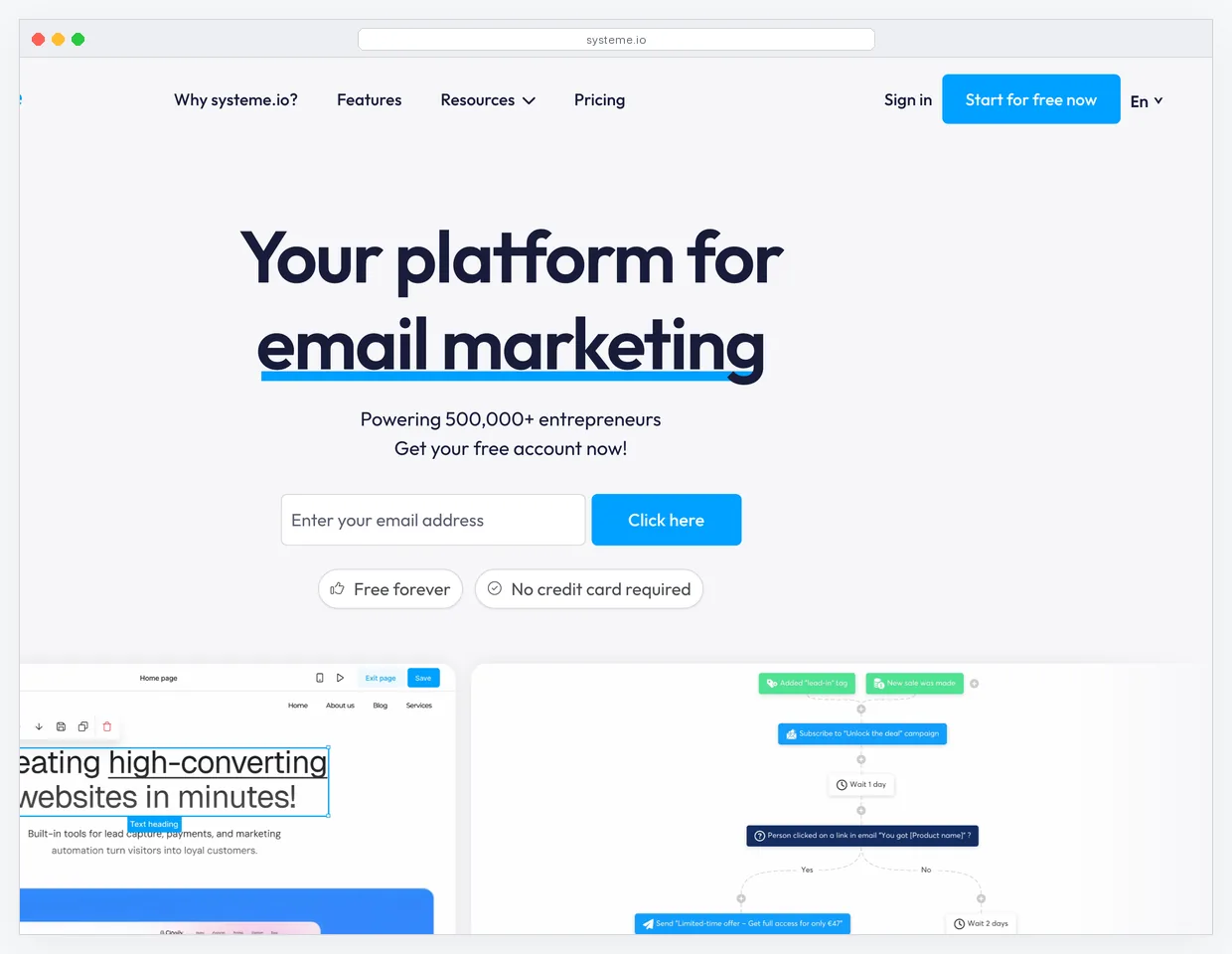
Systeme.io is the platform I push first when a solopreneur asks where to start, because the free plan ships every component you need to test an offer. Funnels, email broadcasts, automations, a course module, an affiliate program, and 2,000 contacts at $0 is a math problem nobody else solves cleanly. The visual funnel builder lacks the design polish of ClickFunnels but produces pages that convert at industry-typical 8 to 12% rates on cold traffic.
Key features:
- Free plan with 3 funnels, 1 course, and 2,000 contacts
- Native email broadcasts plus drip automations
- Built-in affiliate management with payout tracking
- One-click upsells and order bumps in the checkout
- WordPress plugin and custom domain on free tier
Pricing: $0 free plan, $27/mo Startup (5,000 contacts), $47/mo Webinar, $97/mo Unlimited. Annual billing knocks 30% off the monthly rate.
Limitation: The page builder editor feels dated next to ClickFunnels and Kartra. If brand polish is the deciding factor, this will frustrate you. If shipping fast and free is the deciding factor, it does not matter.
For anyone trying to validate before paying, start the Systeme.io free plan and ship a funnel this weekend.
Kartra
Best for: Coaches and digital product sellers running $5K to $50K/mo who want one bill for funnels, email, course, and checkout.
Try Kartra → · Read the full review
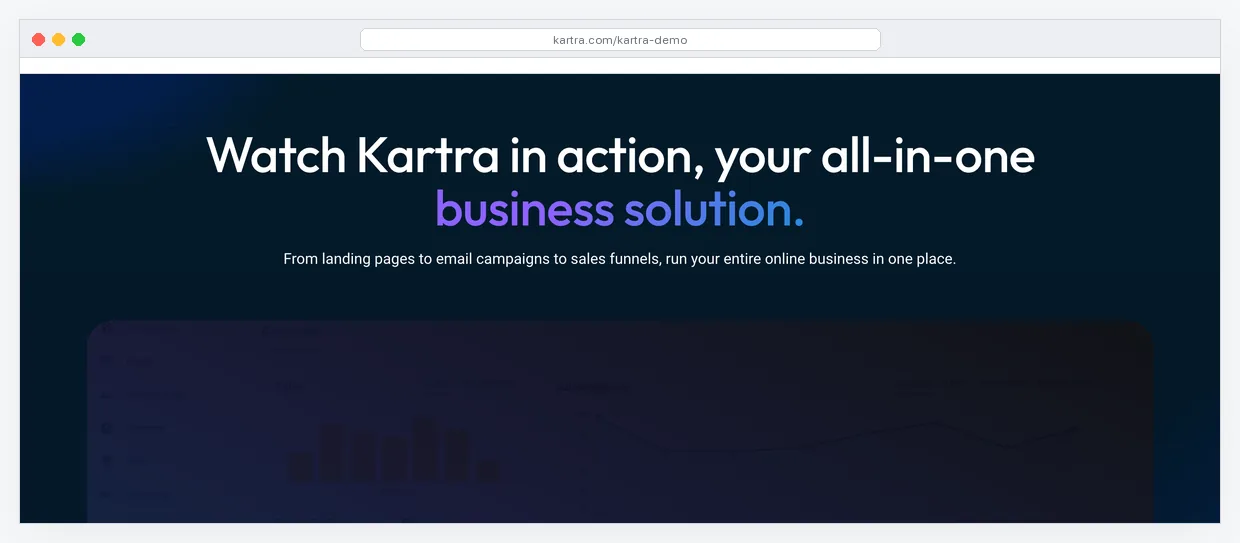
Kartra is what Systeme.io grows into. The page builder ships the cleanest design system in the all-in-one category, the email automation supports behavior-based triggers that ClickFunnels still does not match, and the checkout handles split-pay and subscription billing without a Stripe wrapper. At $119/mo for the Starter plan, Kartra costs more than Systeme.io's mid tier but eliminates the need to bolt on ConvertKit, Calendly, or a separate course platform.
Key features:
- Drag-and-drop page builder with brand-consistent templates
- Behavior-based email automation with tag scoring
- Native checkout with split-pay, trials, and one-click upsells
- Built-in course delivery with progress tracking
- Calendar booking and webinar replay hosting
Pricing: $119/mo Starter (2,500 leads), $229/mo Growth, $549/mo Pro. 14-day trial available.
Limitation: The 2,500-contact cap on Starter means anyone past their first launch will hit the upgrade wall fast. Budget the Growth plan if you are above 2,000 leads at signup.
For mid-stage operators consolidating from 4+ point tools, start the Kartra trial and migrate one funnel to test the workflow.
Email and nurture
If only one line item ships in a launch budget, email wins. Litmus's 2024 number is $36 per $1, and that ratio holds even on a 1,000-person list when the segmentation is right. The two picks below cover newsletter growth and behavior-based automation respectively.
beehiiv
Best for: Newsletter operators monetizing with paid subscriptions, sponsorships, or referral programs.
Try beehiiv → · Read the full review
beehiiv was built by ex-Morning Brew operators specifically for newsletter monetization, and that DNA shows up in the product. The free plan supports 2,500 subscribers with full publishing, custom domain, and the recommendation network. Above that, the paid tiers unlock paid subscriptions, the ad network, and the boost referral system that turned newsletters like Milk Road and The Hustle's spinoffs into real businesses.
Key features:
- Free plan with 2,500 subscribers and custom domain
- Paid subscription module with Stripe-native billing
- beehiiv Ad Network for sponsorship marketplace access
- Boost referral program for paid list-building
- Built-in podcast hosting on the Scale tier
Pricing: Free up to 2,500 subscribers, $49/mo Scale (10K subs, paid subscriptions), $99/mo Max (100K subs). Annual billing saves 20%.
Limitation: The automation engine is lighter than GetResponse or Kartra. Behavior triggers are limited to subscribe events and tag changes. If your nurture flow needs site-action triggers, pair beehiiv with Make.
For anyone monetizing content directly, launch a free beehiiv newsletter and lock in the custom domain before scale tier.
GetResponse
Best for: Lists between 1,000 and 25,000 subscribers running multi-channel automation with webinars, SMS, and AI generation.
Try GetResponse → · Read the full review
GetResponse sits in the sweet spot between ConvertKit's simplicity and ActiveCampaign's depth. The visual workflow builder handles 30+ trigger types, and the platform ships native webinar hosting, SMS, and a landing page module on plans that start at $19/mo. For a 5,000-subscriber list paying $39/mo on the Email Marketing plan, the per-subscriber cost lands at $0.0078, which is roughly half of ActiveCampaign at the same volume.
Key features:
- Visual automation builder with conditional branching
- Native webinar platform with up to 1,000 attendees
- SMS, push, and chat alongside email in one cadence
- AI email generator and AI subject line testing
- Conversion funnel module with templates
Pricing: $19/mo Email Marketing (1,000 contacts), $59/mo Marketing Automation, $119/mo Ecommerce Marketing. 30-day full-feature trial, no card required.
Limitation: The page builder lags Kartra and ClickFunnels on design polish. Strong on email, mid on landing pages.
For lists past 1,000 contacts that need real automation, start the GetResponse 30-day trial and import your list before committing.
Sales funnels and checkout
The funnel layer is where decisions happen. A 1% lift on a $97 product across 1,000 monthly visitors is $970 in extra revenue per month, which more than covers any tool in this category for a year. The pick below is the platform Russell Brunson's team built specifically to extract conversions from cold traffic.
ClickFunnels
Best for: Info-product sellers and high-ticket coaches who optimize on funnel CVR rather than email open rates.
Try ClickFunnels → · Read the full review
ClickFunnels 2.0 is the most opinionated funnel builder on the market. The templates ship pre-tested through DotCom Secrets and Expert Secrets's playbook libraries, which means the layouts already account for the friction points that lose conversions on every other no-code page builder. For high-ticket coaches running $1K+ offers, the design polish matters because a 0.5% CVR lift on a $1,000 product across 500 visitors is $2,500/mo extra.
Key features:
- 2.0 page builder with site-wide design system
- Order bumps, upsells, and downsells in the funnel flow
- Native course builder for membership funnels
- Built-in affiliate program for warm referral sales
- A/B testing on every page element with funnel-level reporting
Pricing: $97/mo Startup (3 funnels), $297/mo Pro (unlimited funnels and courses). 14-day trial. No annual discount published as of April 2026.
Limitation: Pricing starts at $97/mo, which is $97 more than Systeme.io's free plan. If your offer has not closed a single sale yet, validate on Systeme first and migrate when the math works.
For coaches running paid traffic to a high-ticket offer, try ClickFunnels for 14 days and clone one of their pre-tested high-ticket templates.
Agency CRM and pipeline
If the business model serves clients rather than digital products, the CRM layer becomes the spine of the stack. Agency operators running 5+ accounts need pipeline tracking, white-label client portals, and bundled SMS plus email plus calendar in one place. One pick dominates this category in 2026.
GoHighLevel
Best for: Marketing agencies, freelancers serving local businesses, and consultants running 3+ client accounts.
Try GoHighLevel → · Read the full review
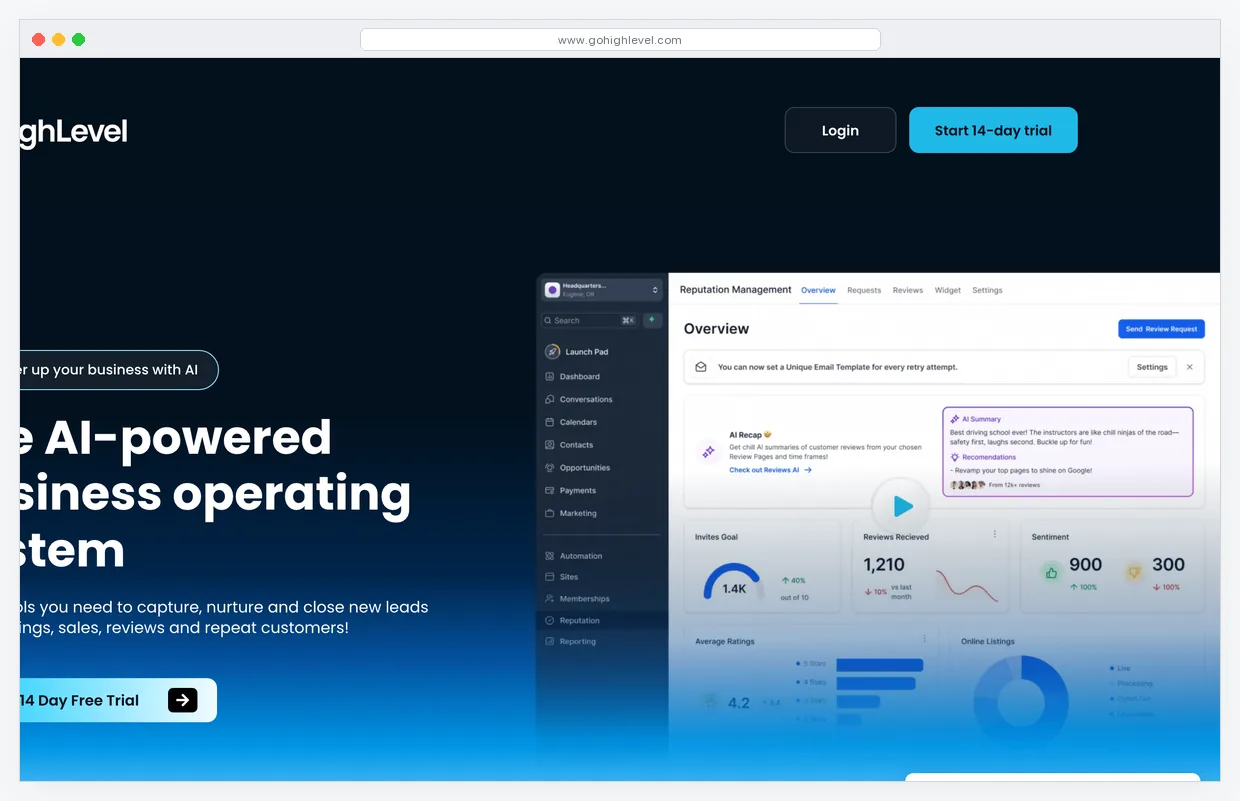
GoHighLevel collapsed the agency tooling stack from $400/mo of point tools into one $97 to $497/mo bill. The Unlimited Agency plan at $297/mo includes white-label client portals, which means an agency operator running 10 clients pays $30/client/mo for a CRM that the client perceives as branded software. The math works at scale and the platform is the fastest-growing CRM in the small-agency segment.
Key features:
- White-label client dashboards on the $297/mo plan
- Native SMS, email, and voice in one inbox
- Calendar booking with round-robin and routing logic
- Pipeline automation triggered by any contact event
- Reputation management with review request flows
Pricing: $97/mo Starter (single account), $297/mo Unlimited (white-label, unlimited clients), $497/mo Pro (SaaS rebill mode). 14-day trial.
Limitation: The interface is dense. Plan a half-day onboarding for the first client account, half that for every account after. The learning curve is the price of consolidation.
For agency operators consolidating client tooling, start the GoHighLevel trial and migrate one client account to test the workflow.
All-in-one math gotcha
An all-in-one platform looks cheaper on the bill, but if you only use 3 of its 8 modules, you are paying for 5 modules of overhead. Run the audit. Sum the standalone cost of each module you actually use, then compare to the all-in-one total. The break-even is usually 4 modules in active use.
Capture and landing pages
The all-in-one platforms above ship landing pages, but a dedicated builder still wins when the marketing job is paid traffic with high page-volume A/B testing. The pick below shipped an AI page generator in 2025 that cuts time-to-first-test by roughly 70%.
LanderLab
Best for: Performance marketers running paid traffic who need to spin up 10+ landing pages a week.
Try LanderLab → · Read the full review
LanderLab is the pick for performance marketers because the AI page generator produces a working variant in under 90 seconds from a single prompt. The infrastructure ships on Cloudflare with sub-100ms global TTFB, which matters because a 100ms page load delay correlates to roughly 1% drop in conversion rate per Google's Web Vitals research. For paid-traffic operators running $1K+/day in spend, the speed and the variant velocity together pay back the $49/mo Starter plan in a single afternoon.
Key features:
- AI page generation from prompt or competitor URL
- Cloudflare-backed hosting with sub-100ms TTFB
- Native A/B testing with traffic split rules
- Pixel and tag management without code edits
- Custom domains on every plan including Starter
Pricing: $49/mo Starter, $99/mo Growth, $199/mo Agency. 7-day trial.
Limitation: The 7-day trial is short. Plan to test on a real campaign during the trial window or you will not have time to see conversion data before the upgrade decision.
For paid-traffic operators, start the LanderLab trial and ship one variant against your current control on day 1.
10Web
Best for: Founders launching a brand-new website who want a real WordPress site without learning WordPress.
Try 10Web → · Read the full review
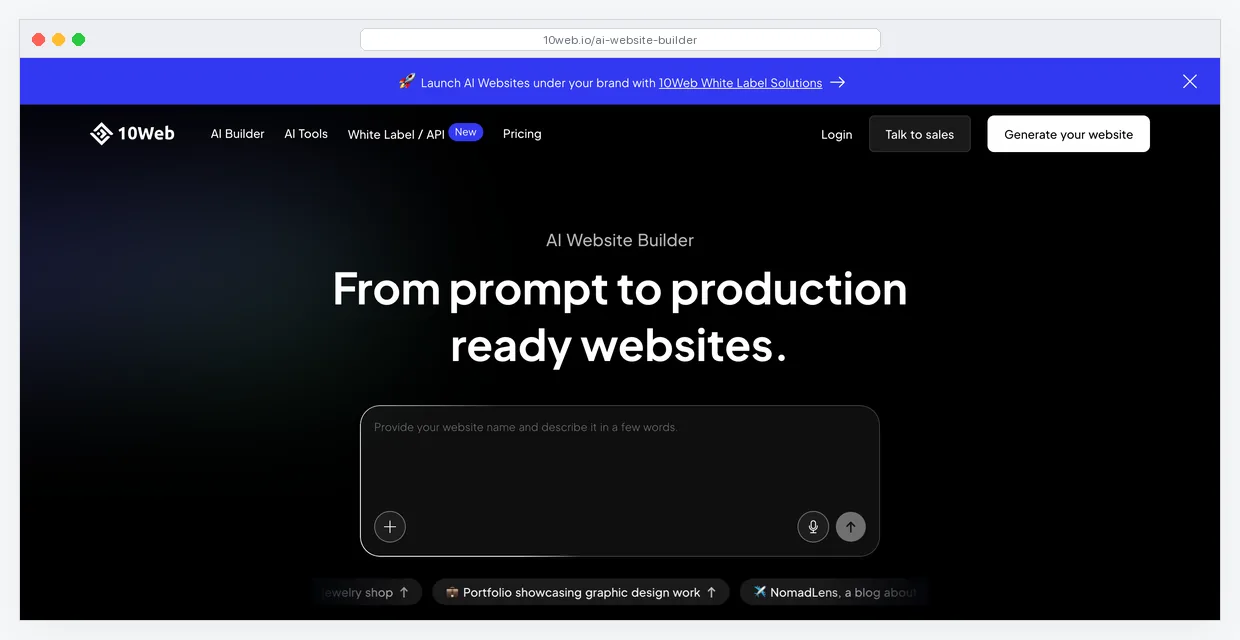
10Web's AI builder generates a full WordPress site from a prompt or an existing competitor URL, then hosts it on Google Cloud with managed updates. For a solopreneur launching a service site or a brochure site for a small business, the output is a real WordPress install you can hand to a developer later if the project grows. Pricing starts at $10/mo, which is below most managed WordPress hosts on its own, before you count the AI build feature.
Key features:
- AI website generation from prompt or URL clone
- Managed WordPress hosting on Google Cloud
- Built-in PageSpeed optimization and image compression
- Drag-and-drop editor on top of WordPress core
- Free site migration from existing hosts
Pricing: $10/mo Personal AI, $24/mo Premium AI, $60/mo Agency. 7-day trial.
Limitation: The AI build still needs editorial cleanup. Expect 1 to 2 hours of post-generation editing to ship a presentable site.
For founders who want a real WordPress site without the WordPress learning curve, try 10Web's AI builder.
Automation and integrations
Automation is the connective tissue. The native integrations on Systeme.io, Kartra, and GoHighLevel cover roughly 70% of typical workflows, but the last 30% requires a dedicated automation platform. Make sits at the right price and depth for solopreneur and small-team budgets.
Make
Best for: Anyone connecting 3+ tools that lack native integrations, especially custom CRM-to-Stripe-to-Slack flows.
Try Make → · Read the full review
Make is the price-performance winner in workflow automation. The free plan ships 1,000 operations a month, which covers a small list moving roughly 30 contacts a day through a 3-step automation. The visual scenario builder is the cleanest in the category, and the per-operation pricing means a high-volume scenario at 50,000 operations costs $29/mo on Core. The same volume on Zapier costs $179/mo. According to Crunchbase coverage of the automation market, Make's volume pricing is the reason it is gaining share in mid-market.
Key features:
- Visual scenario builder with branching and error handling
- 1,000 operations/month on the free plan
- Per-operation pricing scales linearly without surprise overages
- Native HTTP and webhook modules for custom APIs
- 2,000+ pre-built app integrations
Pricing: $0 free (1K ops), $9/mo Core (10K ops), $16/mo Pro (10K ops + features), $29/mo Teams. Custom Enterprise above.
Limitation: The learning curve is steeper than Zapier. The first scenario takes 30 to 60 minutes for a non-technical operator to wire correctly.
For anyone connecting more than 2 tools, start the Make free plan and rebuild your most-used Zap in Make to compare.
Ads and creative
Paid traffic without creative testing is just lighting cash on fire. AI creative tools collapsed the cost of a new ad variant from $50 of designer time to roughly $0.30 of compute, which means small operators can now test 20 variants for what one used to cost.
GetHookd
Best for: Performance marketers running Meta and TikTok ads who need 5+ UGC-style variants per week without a creator network.
Try GetHookd → · Read the full review
GetHookd produces UGC-style ad creative from a product URL or upload in under 3 minutes. The output is good enough for cold-traffic top-of-funnel testing on Meta and TikTok, where the algorithm rewards variant velocity over production polish. For a $5K/mo Meta budget, generating 20 variants instead of 4 typically lifts CPA by 15 to 25% based on the variant-velocity research published by major DTC operators.
Key features:
- UGC-style video generation from product URL or image
- AI hook script library trained on top-performing ads
- Multi-aspect-ratio export for Meta, TikTok, and YouTube
- Voice cloning for branded creator personas
- Bulk variant generation for paid traffic operators
Pricing: $29/mo Starter (10 generations), $59/mo Growth (50), $99/mo Agency (200). 7-day trial.
Limitation: Bottom-of-funnel ads still need a real creator. Treat GetHookd as a top-of-funnel testing engine, not a creative replacement for retargeting.
For paid traffic operators who need variant velocity, start the GetHookd trial and ship 5 variants against your current control.
SEO and research
Organic traffic is still the cheapest qualified pipeline a marketer can build, but the entry cost on the research side has gone up. Free SEO tools cap out fast and most operators eventually pay for one platform. Semrush is the default for the same reason every team that does enough SEO ends up there.
Semrush
Best for: In-house marketers and content teams shipping 4+ articles a month who need keyword data, backlink intelligence, and competitor research in one place.
Try Semrush → · Read the full review
Semrush is the SEO platform that pays for itself fastest at the small-business tier because the keyword data drives both content planning and paid search bidding. For a content team writing one $200 article per week, identifying a single keyword that ranks page 1 and drives 500 monthly clicks at a $2 EPC pays back the $140/mo Pro plan in under 30 days. The competitor analysis tool is the part that turns the platform from research into strategy.
Key features:
- Keyword research with intent classification and SERP features
- Backlink analysis with disavow file generation
- Competitor research showing keyword overlap and traffic gaps
- Site audit with technical SEO scoring
- Position tracking with custom location and device targeting
Pricing: $140/mo Pro, $250/mo Guru, $500/mo Business. 7-day trial available periodically.
Limitation: The Pro plan caps at 5 projects and 500 tracked keywords. Anyone running 5+ client sites needs Guru tier minimum.
For any marketer doing real SEO work, try Semrush and run a competitor gap analysis on day 1.
Content and workspace
Marketing operations live somewhere. For most solo operators and small teams, that somewhere is Notion. The reason it shows up on this list is that it doubles as the content brief, the editorial calendar, and the project tracker, which means one tool replaces Trello, Google Docs, and Airtable for most marketing workflows.
Notion
Best for: Solo marketers and small teams running content calendars, briefs, and project tracking from one workspace.
Try Notion → · Read the full review
Notion is the cheapest project management plus content ops layer that a marketing team can run. The free plan supports unlimited pages and blocks for a single user, which covers any solopreneur indefinitely. The database feature replaces Airtable for content calendars, the docs feature replaces Google Docs for briefs, and the AI assist is built into every page on paid plans starting at $20/user/mo.
Key features:
- Free unlimited pages and blocks for individual users
- Databases with Kanban, calendar, and gallery views
- Notion AI built into every page on paid plans
- Connected docs that link content briefs to calendars
- API for programmatic content workflows with Make
Pricing: $0 free for individuals, $10/user/mo Plus, $20/user/mo Business with AI. Annual billing saves 20%.
Limitation: Notion is not a real project tracker for engineering teams. For a marketing team it covers everything. For a hybrid product team it falls short of Linear or Asana on roadmapping.
For solo marketers running content from one place, try Notion free and clone a content calendar template.
Three pre-built stacks: $0, $99, and $299
The function map above is the menu. The three stacks below are the order. Each one is built to cover the seven jobs of a marketing department at a different revenue stage.
The $0 launch stack
Systeme.io free plan plus beehiiv free plan plus Make free plan plus Notion free. Total: $0/mo. Covers funnels, email, automation, and content ops up to roughly 2,500 contacts and 1,000 monthly automations. Validates an offer before paying anything.
The $99 growth stack
GetResponse Email Marketing at $19/mo plus LanderLab Starter at $49/mo plus Make Core at $9/mo plus Notion Plus at $10/user/mo plus 10Web Personal AI at $10/mo. Total: $97/mo. Covers email automation, paid-traffic landing pages, custom workflows, content ops, and a brand site.
The $299 scale stack
Kartra Starter at $119/mo plus GoHighLevel Starter at $97/mo plus Semrush Pro at $140/mo (use during launch sprints). Total roughly $356/mo, drop Semrush off-cycle to land at $216/mo. Covers funnels, course delivery, agency CRM, white-label clients, and SEO research at a $30K to $100K MRR business.
The mistake to avoid is buying the $299 stack at $5K MRR or buying the $0 stack at $50K MRR. Match the stack to the revenue, then layer in specialty tools like GetHookd for ads or Lemlist for cold outreach as the channel matures.
Frequently asked questions
What counts as a no-code marketing tool in 2026?
A no-code marketing tool ships a visual builder that produces working output without requiring HTML, CSS, JavaScript, or API code from the user. The bar in 2026 has moved higher than drag-and-drop. The platform also has to handle the integration layer with prebuilt connectors, pixel and tag management without code edits, and conditional logic in a visual interface. Tools that still require copying webhook URLs or pasting tracking pixels into a head tag are partial-no-code at best.
Can a solopreneur really run all marketing functions on no-code tools?
Yes, with one caveat. The seven jobs of marketing, capture, nurture, sell, automate, advertise, publish, and measure, are now fully covered by no-code platforms in 2026. The caveat is custom integrations between platforms that lack native connectors. For those, Make's free 1,000 operations per month covers most solopreneur volumes. Past that, the $9/mo Core plan handles 10,000 operations, which is roughly 300 contacts a day moving through a 1-step automation.
How much should a solo marketer budget for tools per month?
The honest answer scales with revenue. At $0 to $5K MRR, the $0 stack with Systeme.io and beehiiv is right. At $5K to $30K MRR, $99/mo across GetResponse, LanderLab, Make, Notion, and 10Web covers everything. Above $30K MRR, the $299 stack with Kartra and GoHighLevel makes sense. Marketing tooling should not exceed roughly 5% of revenue at any stage.
Is GoHighLevel really cheaper than running point tools for an agency?
For agencies running 5+ client accounts, yes. The $297/mo Unlimited plan provides white-label dashboards for unlimited clients. Compare that to running a separate ConvertKit, Calendly, Zoom, and Pipedrive setup at roughly $400/mo for a single client, and the math flips at 2 clients. The trade-off is a steeper learning curve and less depth in any single feature versus best-of-breed point tools.
What is the fastest no-code stack to launch a digital product in a weekend?
Systeme.io free plan covers it. Build the funnel page on Saturday morning, write the welcome email sequence on Saturday afternoon, run a soft launch to a personal list on Sunday. Cost: $0. Time: about 6 to 8 hours. The same launch on Kartra plus ConvertKit plus a separate course platform takes roughly 14 hours and costs $190/mo before the first sale.
Next steps
Pick the stack that matches the current revenue stage and ship one funnel inside it this week. The $0 stack is the right call for any operator below $5K MRR. The $99 and $299 stacks earn their cost only when there is real volume to support them. Buying ahead of the volume is a tax that adds up fast.
For more context on stacking these picks for specific business types, see the top 5 no-code tools for business guide, the $0 marketing stack breakdown, and the no-code AI marketing automation playbook. For adjacent picks across CRM, email, and AI tooling, browse the AI tools directory.